D Scaling Engineering Teams in LATAM: A Time and Materials Playbook for Agile Growth
Por Redacción Aguayo
Scaling engineering teams in LATAM has evolved from a simple cost-reduction tactic into a strategic necessity for product organizations facing severe domestic talent shortages. However, many technology leaders struggle with volatile product roadmaps, prolonged onboarding timelines, and rigid contract structures that stifle innovation. Failing to align team expansion with flexible procurement models directly degrades engineering velocity and inflates technical debt. This playbook delivers a operational framework using Time and Materials (T&M) structures to build highly adaptable, high-performing engineering hubs in Latin America that integrate seamlessly with your core product operations.
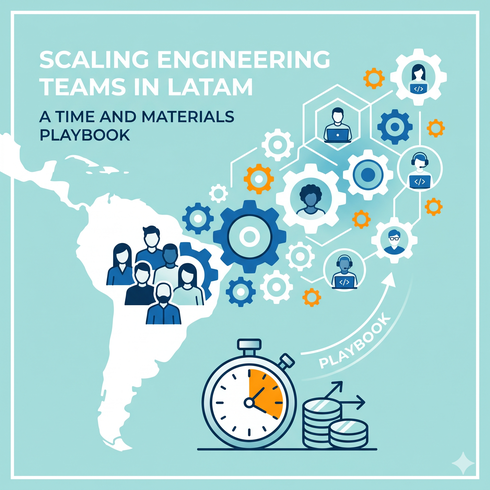
Scaling engineering teams in LATAM through a Time and Materials framework allows organizations to adjust resource capacity dynamically based on real-time product requirements. This model eliminates the constraints of fixed-scope contracts, enabling engineering leaders to onboard specialized talent rapidly, pivot development priorities without penalty, and maintain continuous delivery pipelines.
- Unmatched Scope Flexibility: Modify features, tech stacks, and team composition instantly as your product discovery uncovers new user requirements.
- Immediate Time-to-Market Advantage: Bypass lengthy estimation phases and start onboarding pre-vetted LATAM engineers within days rather than months.
- Complete Operational Transparency: Pay exclusively for documented hours worked, utilizing agile metrics to track velocity, code quality, and ROI directly.
- Time-Zone and Cultural Synergy: Leverage overlapping working hours (EST/CST) and high cultural alignment to foster real-time, frictionless collaboration.
The Strategic Shift to Flexible Engineering Hubs
Mindset Shift: From Fixed Capacity to Elastic Engineering
Traditional outsourcing relies heavily on rigid, fixed-scope contracts that assume product requirements remain static. Modern product development requires a fundamental shift toward elasticity. When scaling engineering teams in LATAM, treating talent acquisition as an adjustable utility rather than a permanent overhead allows companies to survive market volatility. Leaders must stop viewing nearshore talent as an isolated execution vendor and instead integrate them as core contributors to the product lifecycle. This psychological shift ensures that remote engineers are empowered to make architectural decisions, decreasing dependency on internal bottlenecks and accelerating release cycles.
Evidence-Based Prioritization: Data-Driven Resource Allocation
Successful scaling engineering teams in LATAM cannot rely on intuition; it demands continuous evaluation of engineering metrics. By adopting a Time and Materials framework, resource allocation becomes directly tied to team velocity, sprint burndown rates, and deployment frequency. When data reveals a bottleneck in the QA pipeline or a surge in backend infrastructure demands, leadership can immediately scale specific competencies up or down. Organizations leveraging this model analyze historical sprint data to forecast exact capacity needs, ensuring capital is deployed precisely where it yields the highest feature impact.
Cross-Departmental Collaboration: Aligning Product, Engineering, and Procurement
Siloed operations frequently kill nearshore initiatives before they deliver value. Scaling engineering teams in LATAM under a Time and Materials playbook requires continuous synchronization between product managers, engineering directors, and finance departments. Procurement teams must move away from demanding fixed-price guarantees and instead establish master service agreements that define clear governance, daily communication protocols, and flexible billing cycles. Simultaneously, product managers must maintain a highly groomed backlog, allowing the expanded LATAM engineering team to pull tasks autonomously and remain fully utilized without waiting for overhead approvals.
Frequently Asked Questions
Why is Time and Materials better than Fixed-Price for scaling engineering teams in LATAM?
Fixed-price contracts require complete requirement certainty, which rarely exists in modern software development. Time and Materials provides the fluidity needed to adapt to changing product backlogs, experiment with new technologies, and scale team sizes up or down without undergoing complex, costly contract renegotiations.
How do you manage culture and communication gaps with LATAM developers?
Latin American tech hubs share significant time-zone overlap with North America, enabling synchronous daily standups and pair programming. Overcoming cultural nuances requires incorporating nearshore engineers into all core Slack channels, documentation platforms, and team rituals, treating them as internal peers.
What mechanism ensures code quality when rapidly scaling engineering teams in LATAM?
Quality is maintained by enforcing strict definition of done criteria, mandatory peer code reviews, and automated CI/CD pipelines. At Aguayo, establishing clear architectural guardrails and integrating automated testing from day one ensures that distributed teams maintain high velocity without accumulating technical debt.
How does the Time and Materials model impact budgeting and predictability?
While the scope remains variable, budgeting is managed by setting monthly or sprint-based financial caps. This provides leadership with fiscal predictability based on historical team velocity and hourly rates, combining financial guardrails with operational agility.
Conclusion: the Flexible Scale Paradigm
Adopting a Time and Materials framework for engineering expansion represents a fundamental evolution in how modern technology companies build software products. By matching the flexibility of your procurement model with the volatility of your product roadmap, your organization eliminates the friction typically associated with traditional vendor management. This approach transforms Latin America from a simple talent source into a strategic powerhouse for sustainable, high-velocity innovation.
To maximize this transition, leadership must commit to continuous data collection, transparent cross-border communication, and a culture that values engineering autonomy. The organizations that successfully integrate these principles will outpace competitors trapped in rigid contracts, establishing a highly resilient workforce capable of pivoting whenever market demands shift.
Ultimately, scaling engineering teams in LATAM is not an exercise in finding cheaper labor, but rather an intentional strategy to build elastic capability. When executed with clear metrics and a collaborative mindset, this playbook provides the operational foundation required to sustain product quality and accelerate business growth over the long term.