D UX Design for Wearable Devices
Por Redacción Aguayo
When designing experiences for wearables, we step into a space where the interface is no longer just visual—it becomes something you feel, something you wear, and, in many cases, something that merges with your body or surroundings. Devices like smartwatches, augmented reality (AR) glasses, and virtual reality (VR) headsets have radically changed how we interact with technology. It’s no longer about clicking; it’s about moving, looking, touching, even speaking. This kind of design requires us to think beyond the screen: to consider context, physical limitations, and entirely new languages of interaction. 🧠
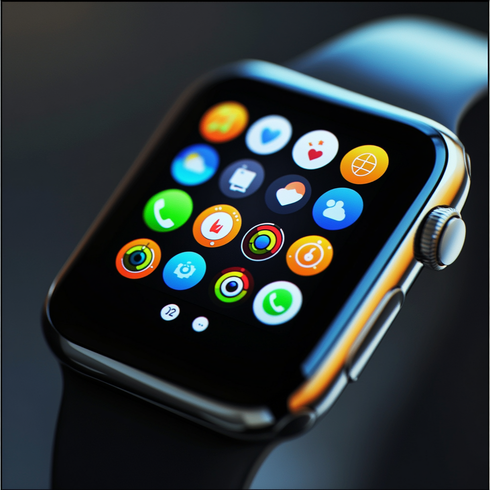
Smartwatches: Microinteractions with a Big Impact
Smartwatches force us to think in ultra-compact UX. Every pixel counts, and the user’s attention span is minimal. UX design for smartwatches must avoid distractions—it needs to be clear, direct, and extremely functional. Unlike phones, smartwatches are made for quick glances. This imposes strict rules but also opens up unique opportunities.
Simplified Information Hierarchy
Small screens demand fast decisions. Information must be structured in ultra-light layers. Essentials come first; secondary details should be easily accessible. This translates into efficient microtext, smooth animations, and a clean visual language.
Hands-Free Interaction
Often, users can’t—or don’t want to—use their hands. While driving, running, or cooking, for example. In these scenarios, wrist gestures, voice commands, and quick replies (like answering a message with a predefined phrase) become essential.
Always-On Context
Wearables live with the user. This allows the experience to adapt in real time to location, movement, and physical state. If the watch detects you're walking, it can change how it presents a notification. If it knows you're in a meeting (thanks to your calendar), it can silence alerts automatically.
Visually Optimized Design
Readable typography, large icons, accessible buttons, and strong contrast for outdoor conditions. The environment in which a smartwatch is used (direct sunlight, movement, weather) demands a design that performs reliably in all scenarios.
Augmented Reality: Digital Layers Over the Physical World
Augmented reality introduces digital elements that coexist with our physical surroundings. It's a floating layer of information and interaction that must be seamlessly integrated to avoid disrupting the real-world experience. UX design here becomes three-dimensional, environmental, and highly contextual—more so than in traditional screen-based designs.
- Non-Invasive Overlays
Visual elements must integrate into the environment without blocking vision. Their position, scale, and opacity must be carefully designed so the interface doesn’t overwhelm. For instance, in an AR navigation app, arrows should align with the street, not float aimlessly. - Multimodal Feedback
Since users are on the move, tactile, audio, or subtle animated feedback is crucial. Visual alone isn’t enough. A notification might include a gentle vibration or an ambient color shift to guide attention. - Movement-Guided UX
Natural gestures (looking, focusing, walking) are central to interaction. UX must account for user movement and avoid requiring them to stop and manipulate complex inputs. Head tilts or gaze direction can be more intuitive than tapping a button. - Spatial Design
Consider the “architecture” of virtual elements. Where will they appear? At what distance? Do they scale to the real-world environment? Latency must also be considered: if elements appear with a delay, the experience loses credibility and immersion.
Virtual Reality: Full Immersion Requires New Rules
In virtual reality, users enter entirely digital environments. This fundamentally changes our reference points for navigation and content. The screen is no longer a flat surface—it’s a space to inhabit. UX in VR is more than navigation: it’s about creating presence, atmosphere, and comfort.
Presence-Centered Design
Feeling “inside” the digital space is essential. This is achieved with natural interactions, immediate feedback, and immersive environments. Response time must be near-instant to avoid emotional or physical disconnection.
Three-Dimensional UX
We no longer design screens—we design spaces. Menus can float, buttons can have depth, and navigation happens through walking, looking, or using spatial controllers. Visual anchor points are important so users don’t feel lost in a scene with no orientation.
Reducing Cognitive and Physical Fatigue
Virtual environments must be comfortable for extended use. Avoid sudden movements, cluttered interfaces, or awkward transitions. Actions should require minimal physical effort—users shouldn’t constantly stretch their arms or hold uncomfortable postures.
Digital Ergonomics
Even in virtual worlds, the body matters. UX must account for posture, viewing angles, and physical limitations to prevent dizziness or discomfort. Spaces should respect personal boundaries and offer visual or physical rest zones.
Designing for Movement: The Core Challenge of Wearables
Designing for wearables isn’t just about resizing interfaces or tweaking flows. It’s about changing the very logic of design—from screen-bound to body-aware. It invites us to consider technology not as a separate tool, but as an extension of the human body.
- Ephemeral Interfaces
Often, users will only see the interface for a second. The design must communicate in micro-moments. This reshapes how we prioritize information and craft intuitive interactions that require no prior learning. - Environmental Interactions
Wearables can detect light, sound, proximity, or temperature. Using these sensors to adapt the experience can greatly improve product usefulness. Imagine AR glasses dimming visual alerts when they detect you’re driving. - Contextual Privacy
Wearables access intimate data (heart rate, location, emotional state), so it’s crucial to design interactions that communicate trust and transparency. Show clearly what data is being used and allow users to control it—this is part of ethical UX. - Consistency Without Rigidity
The experience should be consistent across devices and contexts (mobile, wearable, desktop), without enforcing rigid structures. UX for wearables should feel like a natural extension of both body and environment.
Tools, Methodologies, and Sensory Exploration
UX design for wearables also requires new tools, workflows, and research strategies. Wireframes in Figma are no longer enough. Designers need simulations, real-world testing, and sensory analysis to validate their decisions.
Immersive Prototyping
Tools like Unity, Unreal Engine, or WebXR platforms enable experiences that can be felt and tested in real-life conditions. Interactive prototypes, spatial maps, and physical animations become essential validation methods.
Field Testing
Real context is key. You can’t evaluate a smartwatch design at your desk. Testing must happen while users are engaged in real activities—walking, commuting, or navigating busy environments.
Voice and Gesture Design
Not all wearables use buttons. Voice interaction tools (like Voiceflow) and gesture recognition libraries are fundamental. Designers must identify which gestures are natural, which are repeated, and which cause fatigue.
Emotional and Multisensory UX
When technology becomes wearable, it also becomes intimate. UX must integrate emotional, sensory, and affective dimensions. Subtle vibrations, soft sounds, gentle transitions or color shifts can define whether a user feels overwhelmed—or comforted—by an experience.
The Hybrid Future: From the Body to the Environment
Designing for wearables challenges us to expand the very notion of an interface. The body, the environment, mood, movement, and time all become active variables in the design of experiences. There is no single screen—there is an ecosystem where every element plays a contextual role.
Devices will disappear as they become integrated with us. And as designers, we must prepare to build experiences that speak the language of the body, not just the language of the screen.
Designing in Motion: The Great Challenge of Wearables
Designing for wearables is not just about resizing interfaces or adapting flows. It’s about changing the design logic from desktop-based to movement-based. We must understand how technology is lived in different contexts: while walking, running, cooking, working, or playing.
Ephemeral Interfaces
Often, users will see the interface for only a second. The design must communicate in micro-moments. This changes how we prioritize information and how we design interactions that require no prior learning.
Environmental Interactions
Wearables can detect light, sound, proximity, or temperature. Leveraging these sensors to adapt the experience can significantly improve product value. Imagine AR glasses that automatically dim visual alerts when they detect you’re driving.
Contextual Privacy
Wearables access highly personal information (heart rate, location, etc.), so it’s crucial to design interactions that convey trust and transparency. Showing which data is being used and enabling user control is a pillar of ethical design.
Consistency Without Rigidity
The experience should be consistent across different devices and contexts (mobile, wearable, desktop), without imposing rigid structures. UX for wearables should feel like a natural extension of the body and environment.
Specific Tools and Methodologies
Wearable UX design also requires dedicated tools and processes. Figma or Sketch alone are not enough.
- Immersive Prototyping
Tools like Unity, Unreal Engine, or WebXR allow the creation of prototypes for VR/AR that can be tested in real-time environments.
- Field Testing
Real-world context is key. You can’t evaluate a smartwatch design at a desk. Tests must be done while users perform real activities.
- Voice and Gesture Design
Tools like Voiceflow or VUI are helpful for creating voice-command experiences, and gesture libraries help map out natural interactions.
- Data-Driven UX
Real-time data on usage, movement, and context can continuously improve design. This includes more ethnographic UX research methods, even passive observation.
Emotional and Sensory UX: Beyond the Interface
When technology becomes portable and worn, it also becomes intimate. UX design must take into account emotion, comfort, and even the senses.
Sound as Interface
In environments where vision isn’t enough, sound can guide, inform, or calm. Audio UX design (sonic branding, effects, feedback) is increasingly relevant.
Haptics
Vibrations, pulses, and pressure can inform users without screens. These patterns must be as recognizable as icons.
Functional Aesthetics
In a smartwatch, the strap, weight, or color matter as much as the interface. UX becomes intertwined with industrial design.
Empathetic Design
If the wearable monitors health, sleep, or emotional well-being, the design must convey empathy. Gentle messages, non-invasive interactions, and a human tone are essential.
Toward a Hybrid Future: UX Between the Physical and Digital
The evolution of wearables points toward an increasingly seamless integration between body, environment, and data. As UX designers, this invites us to constantly rethink our tools, approaches, and ethics.
Designing for wearables means designing for the here and now—for the body and its surroundings, not for screens.
Technology dissolves into experience, demanding UX that is more sensory, more natural, more contextual.
The boundary between interface and everyday life is disappearing. UX design for wearables is precisely that bridge between what we feel and what we do with technology.
Conclusion: Designing the Invisible, Creating With the Body in Mind
UX design for wearable devices is not simply a scaled-down version of screen-based design—it’s a complete evolution in how we understand human-technology interaction. It requires letting go of outdated structures centered solely on sight and touch, and instead embracing an ecosystem of experiences where movement, context, voice, proximity, the body's rhythm, and the environment all actively shape the digital narrative.
What makes wearables unique is their ubiquity: they are with us, on us, or even within us. This changes everything. We’re no longer designing for users sitting at a desk—we're designing for people walking through cities, cooking, running in parks, sleeping, or just living their lives with minimal digital friction. This new user demands that our designs be more empathetic, intuitive, and deeply human.
Smartwatches teach us to compress value into seconds. Notifications should support, not distract. Efficient design does not interrupt. AR teaches us to design in layers—digital, physical, spatial, and emotional. It forces us to think not only about what the user sees, but what surrounds what they see. VR immerses us in worlds where interaction is not a click but a gesture, a glance, a head turn, or a sense of “being inside.” It asks us to design entire realities—not just interfaces.
Working with wearables also means accepting that design must be dynamic. Interfaces must respond to changing user contexts, and flows must anticipate multiple simultaneous scenarios: what the user wants, what they can physically do at that moment, and what their environment allows. This level of complexity requires a systemic, interdisciplinary approach, where user experience is choreographed through data, sensors, human behavior, and emotional intention.
In this sense, UX for wearables is not only technical—it is philosophical. It raises tough questions: How do we design for diverse bodies? How do we respect privacy when a device knows our breathing patterns? How do we avoid sensory overload or tech dependence? What role does ethics play when what we design is not just used—but inhabited?
More than a new design field, wearables represent a new design consciousness. They ask us to notice the invisible: the silences, the untracked movements, the in-between moments, what is not seen but felt. Because it’s in that intimate space—where technology and the body intertwine—that true wearable UX lives.
And perhaps the greatest challenge is not technological innovation, but a return to the essential: designing from the human, for the human, in rhythm with the human body. Because when the device disappears into the experience—that’s when we’ve truly designed well.