D Managing Sprint Cycles in a Time and Materials Engagement: Maximizing ROI in Agile Consulting
Por Redacción Aguayo
Organizations shifting to Agile product development often struggle to balance budget predictability with operational flexibility when working with external partners. Managing Sprint Cycles in a Time and Materials Engagement presents a unique challenge: the open-ended nature of the billing model can easily lead to unchecked scope creep and financial bleeding if the product backlog is poorly governed. Without a rigid framework that links engineering hours directly to measurable product increments, businesses face escalating burn rates without guaranteed delivery. This article outlines the precise governance, prioritization, and tracking mechanisms required to maintain fiscal discipline while leveraging the creative freedom of adaptive sprint cycles
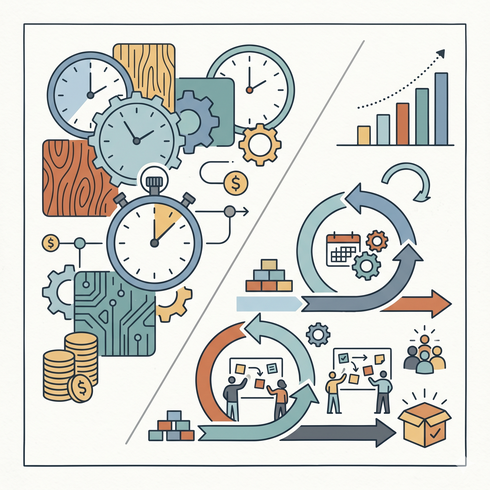
Managing Sprint Cycles in a Time and Materials Engagement requires shifting the focus from tracking billable hours to measuring velocity and working software increments. Success relies on establishing a transparent, dual-governance model where every sprint is bounded by a strict capacity ceiling and driven by a rigorously prioritized backlog. External partners must operate with a predefined definition of done that ensures billed time yields functional value rather than technical debt.
- Establish baseline velocity early: Anchor sprint planning on the team's historical capacity rather than optimistic estimates to prevent budget overruns.
- Enforce a strict prioritization framework: Use evidence-based models like MoSCoW or RICE to ensure billable hours are spent only on high-impact features.
- Tie time tracking to sprint deliverables: Require engineers to log hours against specific Jira epics or GitHub issues instead of generic project codes.
- Monitor the budget burn rate weekly: Treat financial consumption as a primary sprint metric alongside velocity to identify deviations before they compound.
- Implement shared risk-reward parameters: Define clear boundaries where efficiency gains or delivery delays trigger collaborative adjustments in scope or capacity.
Sprints and T&M: The Dynamic of Flexible Engineering
Managing Sprint Cycles in a Time and Materials Engagement demands a fundamental change in how delivery teams and executive stakeholders perceive procurement. In traditional fixed-price contracts, the scope is locked, and the vendor bears the execution risk. In a Time and Materials (T&M) model, the buyer assumes the risk of the scope, which offers immense freedom to pivot based on user feedback but requires ruthless day-to-day management.
At Aguayo, engineering diagnostics show that a significant portion of digital transformation failures stem from teams treating T&M engagements as an open checkbook. Sprints are not a mechanism to experiment indefinitely; they are timeboxed iterations meant to produce production-ready value. When running sprints under a flexible contract, the timebox itself becomes the primary constraint, forcing the product owner to make hard choices at the end of every cycle.
Mindset Shift: From Capacity Buying to Outcome Delivery
The most critical hurdle in managing sprint cycles in a time and materials engagement is moving away from the "body shopping" mentality. Procurement teams often look at T&M as simply buying hours of developer capacity. However, product leaders must treat those hours as investment capital.
Every sprint planning session should begin with a financial reality check: what is the cost of this sprint versus the projected business value of the user stories committed? Teams must stop celebrating the mere utilization of developers and focus entirely on the velocity of shipped features.
Prioritization Based on Evidence and ROI
When scope is fluid, the temptation to add low-value features is high. Managing sprint cycles in a time and materials engagement requires a barrier against arbitrary additions to the product backlog. Every feature request must be justified by user data, product analytics, or clear architectural necessity.
Collaborative Governance Across Product, UX, and Engineering
Silos destroy T&M budgets faster than poor coding. Cross-functional alignment ensures that UX designers do not design complex patterns that require excessive engineering hours to build, and engineers do not over-engineer solutions beyond the immediate product need. Daily standups must include explicit discussions on blockers that directly impact the daily financial burn rate.
Frequently Asked Questions About Sprints in T&M
How do you prevent scope creep when managing sprint cycles in a time and materials engagement?
Scope creep is managed by enforcing a strict "one-in, one-out" rule during the active sprint. If a new requirement is introduced mid-cycle, an equivalent piece of work must be pushed back to the product backlog to protect team capacity.
What is the ideal sprint length for a T&M consulting model?
Two-week sprints are the industry standard because they provide enough time to build meaningful increments while offering frequent touchpoints to assess the financial burn rate and adjust strategic direction.
Should the client or the agency prioritize the backlog in T&M sprints?
The client's Product Owner retains absolute accountability for prioritizing the backlog, while the agency provides technical scoping, estimation accuracy, and delivery execution to guide those decisions.
How do you handle bugs or technical debt under a T&M contract?
Bugs discovered within the sprint boundaries are resolved as part of the sprint's commitment. Historical technical debt must be categorized, prioritized in the backlog, and allocated a fixed percentage of capacity in each sprint.
Conclusion: Velocity control as the driver of sustainable growth
Financial and operational success in agile consulting projects does not depend on the rigidity of an initial contract, but rather on the maturity with which resources are managed week by week. When managing development cycles under time and materials frameworks, absolute transparency in delivery metrics becomes the only guarantee of profitability for the organization. Companies that manage to establish a direct correlation between the cost of their engineering pods and the value of the deployed software transform a traditionally risky model into a highly adaptable competitive advantage.
When the priority shifts from simply monitoring billed hours to the continuous optimization of team velocity, operational waste is drastically reduced. This requires product leaders to maintain a constant commitment to backlog refinement and to refuse to let external pressures dilute the objectives of each iteration. Discipline in executing agile ceremonies acts as the real-time auditing system that protects company capital against unforeseen technical deviations.
Finally, consolidating this constructive approach allows technology teams to respond to market changes without the need to renegotiate complex contract addenda. By adopting an evidence-centered agile governance model, organizations maximize their return on investment and mitigate the financial uncertainty inherent in modern development. Efficient management of these hybrid environments is what truly separates scalable digital products from projects that exhaust their budgets before validating their value proposition.