Aguayo

D Overcoming Cultural Barriers in LATAM-US Remote Collaborations

Por Redacción Aguayo

The shift toward nearshoring has positioned Latin America as the premier partner for US-based technology and design firms. However, many organizations discover that proximity in time zones does not automatically translate to proximity in workplace culture. The friction often arises not from technical inability, but from unaddressed systemic differences in communication, hierarchy, and feedback loops.

For product leaders, CX directors, and CTOs, the challenge of overcoming cultural barriers in LATAM-US remote collaborations is the "last mile" of digital efficiency. Without a deliberate strategy to bridge these gaps, projects face delays, reduced morale, and a lack of authentic innovation. This article explores the deep-seated cultural dimensions that influence these partnerships and provides a roadmap for high-performing, cross-border integration.

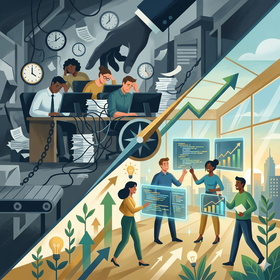
Strategic framework for overcoming cultural barriers in LATAM-US remote collaborations.
CAPTION: Photo generated from Midjourney

The Invisible Architecture of Nearshore Success

Overcoming cultural barriers in LATAM-US remote collaborations requires a transition from "accidental collaboration" to "intentional cultural design." Success is found in balancing the US preference for low-context, direct communication with the LATAM emphasis on high-context, relationship-based trust.

  • Standardize Communication: Move from implicit expectations to explicit documentation.
  • Recalibrate Hierarchy: Encourage "speak-up" cultures in LATAM teams to counter traditional power distances.
  • Focus on Outcomes: Shift the metric of success from "hours stayed" to "value delivered."
  • Invest in Social Capital: Dedicate time for non-transactional interactions to build the "trust battery."
  • Contextualize Feedback: Use frameworks that allow for radical candor without damaging personal relationships.

The globalization of talent has made the "where" of work less relevant than the "how." In the context of the Americas, the geographical alignment is a gift, yet many leaders treat LATAM teams as a plug-and-play resource rather than a complex cultural entity. To move beyond the surface, we must understand that culture is the invisible architecture of every digital product. If the architecture is flawed, the product will eventually crack under the pressure of misaligned expectations.

In our experience at Aguayo, we have observed that the most successful LATAM-US partnerships are those that treat cultural intelligence (CQ) as a core technical requirement. It is not about "fixing" one culture to match the other; it is about creating a third, hybrid culture that leverages the directness of the US and the ingenuity and warmth of Latin America.

1. From Transactional to Relational: A Mindset Shift

In the United States, professional culture is predominantly "task-first." Trust is built through demonstrated competence: you do your job well, and I trust you. In Latin America, culture is "relationship-first." Trust is the prerequisite for work: I trust you as a person, therefore we can do business together.

The Tactic: Directness vs. Harmony In US remote settings, "getting straight to the point" is seen as a sign of respect for the other person's time. In many LATAM cultures, skipping the "social buffer" (the initial check-in about family or well-being) can be perceived as cold or even aggressive. Overcoming cultural barriers in LATAM-US remote collaborations begins with recognizing that five minutes of "small talk" in a daily stand-up is not wasted time—it is a strategic investment in the team's cohesion.

The Strategy: Building the Trust Battery At Aguayo, we advocate for the "Trust Battery" concept. Every interaction either charges or drains this battery. For US leaders, charging the battery means being clear and reliable. For LATAM teams, it means feeling seen and valued beyond their Jira tickets. When the battery is full, miscommunications are forgiven; when it is empty, every Slack message is scrutinized for hidden meanings.

2. Navigating the Power Distance Index (PDI)

One of the most significant hurdles in overcoming cultural barriers in LATAM-US remote collaborations is the difference in Power Distance—the extent to which less powerful members of a team accept that power is distributed unequally.

The Challenge of the "Yes" US tech culture prizes the "flat hierarchy" where a junior designer can challenge a VP's idea. In many Latin American corporate structures, hierarchy is more rigid. A team member might say "yes" to an unrealistic deadline out of respect for authority, rather than a realistic assessment of capacity. This leads to "the silent delay," where the US lead assumes everything is on track until the deadline passes.

Psychological Safety as a Metric To mitigate this, leaders must actively lower the PDI. This involves:

  • Asking Open-Ended Questions: Instead of "Can you do this by Friday?", ask "What obstacles might prevent us from hitting Friday's goal?"
  • Modeling Vulnerability: When US leaders admit they don't have all the answers, it signals to the LATAM team that it is safe to voice uncertainty.
  • Anonymous Feedback Loops: Using tools to gather honest input without the fear of direct confrontation.

3. High-Context vs. Low-Context Communication

The United States is a classic low-context culture. Communication is expected to be precise, simple, and clear. If it isn't in the documentation, it doesn't exist. Latin America tends toward high-context communication, where much of the meaning is conveyed through subtext, tone, and shared history.

Documenting the Undocumented For a US-based Product Manager, a lack of detailed documentation is a failure. For a LATAM developer, it might be seen as an opportunity for "malicia indígena" (a term used in some regions for resourcefulness or "street smarts"). To bridge this, the remote collaboration must adopt a "Documentation-First" policy.

Aguayo's Evidence-Based Approach In projects involving complex UX research or service design, we have found that visual mapping—such as Service Blueprints—acts as a universal language. It moves the conversation from the "context" of the individual's mind to a shared "canvas" that both cultures can interpret with the same level of clarity. This reduces the cognitive load of translating not just language, but intent.

4. Reimagining Agile for the Americas

Agile ceremonies (Stand-ups, Retrospectives, Sprint Planning) are often where cultural friction becomes visible. While the framework is global, the execution is deeply local.

  • The Retrospective: In a culture that prizes "simpatía" (avoiding conflict to maintain harmony), a Retrospective can become a "compliment circle" rather than a rigorous analysis of what went wrong. To overcome this, use structured frameworks like "Stop, Start, Continue" to depersonalize the critique.
  • The Daily Stand-up: Shift the focus from "what I did" to "what value I unlocked." This helps LATAM teams align with the US focus on outcomes while maintaining the social connection of the meeting.

5. The Role of "Glocal" Leadership

Leadership in this remote corridor requires being "Glocal"—having a global mindset with local sensitivity. It means understanding that while the code is written in English, the motivation behind the coder is influenced by their local environment.

Economic and Social Context Leaders must be aware of the external factors affecting their LATAM counterparts. From currency fluctuations to infrastructure challenges (like power outages in certain regions), a "Glocal" leader shows empathy by acknowledging these realities. This doesn't mean lowering the bar for excellence; it means providing the support necessary to reach it.

The "Aguayo" Way: UX as a Bridge We believe that UX is not just a discipline for end-users; it is a discipline for internal teams. By applying UX principles to the way teams collaborate—interviewing team members, mapping their "employee journey," and iterating on the collaboration model—organizations can systematically remove friction.

Preguntas frecuentes sobre Overcoming Cultural Barriers in LATAM-US Remote Collaborations

¿Cuál es la principal diferencia de comunicación entre equipos de EE. UU. y Latinoamérica? La diferencia radica en el contexto. EE. UU. es de "bajo contexto" (directo y explícito), mientras que LATAM es de "alto contexto" (depende de la relación y el subtexto).

¿Cómo afecta la jerarquía al trabajo remoto con equipos de LATAM? Un alto "Power Distance" en LATAM puede inhibir que los empleados cuestionen órdenes de líderes de EE. UU., lo que genera riesgos en la detección temprana de errores.

¿Qué estrategias ayudan a construir confianza en colaboraciones Nearshore? Invertir tiempo en interacciones no transaccionales (socialización) y asegurar que las expectativas de éxito estén claramente documentadas y no solo habladas.

¿Por qué el "agile" a veces falla en equipos multiculturales? Suele fallar por la falta de seguridad psicológica. En culturas que evitan el conflicto, las ceremonias como la retrospectiva no logran identificar fallas críticas por evitar la confrontación.

¿Cómo manejar las diferencias en la percepción del tiempo y plazos? Se debe transicionar de una cultura de "presencialismo" a una de "entrega de valor", definiendo hitos claros y verificables en lugar de solo horas de conexión.

¿Qué rol juega el idioma en las barreras culturales más allá de la gramática? El idioma influye en la asertividad. Un hablante de LATAM puede sonar menos seguro en inglés, lo que lleva a líderes de EE. UU. a subestimar su expertise técnico.

Conclusion: Synthesis for Strategic Integration

The path toward seamless integration is paved with empathy and technical rigor, as organizations that succeed do not ignore differences but instead design systems around them. The transition from tactical execution to strategic partnership requires a profound shift, beginning with the acknowledgment that the "US way" is not a universal standard. While LATAM teams bring a unique blend of creativity, resilience, and problem-solving, these traits are often stifled by rigid, low-context management styles. To unlock full potential, leaders must foster an environment of radical transparency by dismantling traditional hierarchies that prevent honest feedback loops and committing to documentation that leaves no room for ambiguity. At Aguayo, we have seen how these bridges transform simple outsourcing into genuine innovation, maintaining a "trust battery" that remains charged and productive when expectations are clear.

The risk of ignoring cultural barriers is high, often leading to talent churn, missed deadlines, and poor products; in contrast, the reward is a sustainable, high-velocity engine of digital growth. A key step is implementing "cultural onboarding" for every new cross-border hire to explicitly discuss communication styles and feedback preferences. It is vital to avoid assuming that English proficiency equals cultural alignment, as language is merely the medium while culture acts as the message and the operating system. By measuring the health of the collaboration through regular sentiment surveys and iterating on internal processes just like a product, organizations can achieve a hybrid culture where directness meets warmth. Sectors like banking, fintech, and insurance benefit immensely from this diversified perspective, requiring both the precision of US standards and the adaptability of LATAM markets.

Remote work in the Americas is a geographic privilege that we must leverage, but proximity in miles does not guarantee proximity in mission or mindset. Successful leaders act as translators of professional values, creating a workplace that is truly inclusive and highly efficient. Overcoming cultural barriers in LATAM-US remote collaborations is an ongoing journey that requires humility from leadership and a willingness to learn from all sides. Investing in face-to-face meetups and celebrating the unique contributions of each cultural lens ensures that the most resilient products are built by teams that understand each other’s "why." Do not let cultural friction be the bottleneck of your digital transformation; instead, embrace the complexity and turn it into your greatest competitive edge for a future that is collaborative, borderless, and deeply human.
Contact Us

More blog

About work, workshops, creative processes, new clients, old clients, daily life, and UX, epistemological thoughts, and critiques.

scaling-engineering-teams-in-latam-time-and-materials-playbook

Scaling Engineering Teams in LATAM: A Time and Materials Playbook for Agile Growth

Scaling engineering teams in LATAM has evolved from a simple cost-reduction tactic into a strategic necessity for product organizations facing severe domestic talent shortages. However, many technology leaders struggle with volatile product roadmaps, prolonged onboarding timelines, and rigid contract structures that stifle innovation. Failing to align team expansion with flexible procurement models directly degrades engineering velocity and inflates technical debt. This playbook delivers a operational framework using Time and Materials (T&M) structures to build highly adaptable, high-performing engineering hubs in Latin America that integrate seamlessly with your core product operations.

Read entry
managing-sprint-cycles-time-and-materials-engagement-agile-dashboard

Managing Sprint Cycles in a Time and Materials Engagement: Maximizing ROI in Agile Consulting

Organizations shifting to Agile product development often struggle to balance budget predictability with operational flexibility when working with external partners. Managing Sprint Cycles in a Time and Materials Engagement presents a unique challenge: the open-ended nature of the billing model can easily lead to unchecked scope creep and financial bleeding if the product backlog is poorly governed. Without a rigid framework that links engineering hours directly to measurable product increments, businesses face escalating burn rates without guaranteed delivery. This article outlines the precise governance, prioritization, and tracking mechanisms required to maintain fiscal discipline while leveraging the creative freedom of adaptive sprint cycles

Read entry
time-and-materials-vs-outsourcing-talent-retention-chart

Time and Materials vs. Outsourcing retention analysis for product engineering teams

Managing talent continuity in external engineering teams directly impacts product velocity, code quality, and time-to-market. When analyzing Time and Materials vs. Outsourcing retention, product and technology leaders frequently encounter high turnover rates that disrupt sprint cycles and dilute institutional knowledge. Traditional fixed-price outsourcing often incentivizes vendors to optimize for margin over talent satisfaction, resulting in rolling churn that stalls complex product development. Choosing the wrong engagement model creates hidden financial friction, as engineering onboarding cycles consume valuable senior leadership resources and delay core roadmap deliverables.

Read entry
pivoting product strategy in T&M contracts

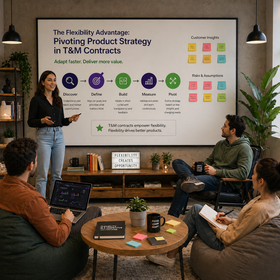
The Flexibility Advantage: Pivoting Product Strategy in T&M Contracts

In the high-stakes world of digital product development, the only constant is change. Traditional fixed-scope contracts often act as a straightjacket, preventing teams from responding to market shifts or user feedback discovered during the build. This is where the strategic advantage of Time and Materials (T&M) models becomes apparent, offering the structural freedom necessary for high-growth companies.

Pivoting product strategy in T&M contracts is not merely about changing direction; it is about leveraging financial and operational flexibility to maximize business value. For product leaders, CX directors, and CTOs, understanding how to navigate these pivots is the difference between a failed launch and a market-leading innovation.

This article explores the mechanics of successful strategic shifts within T&M frameworks. We will analyze how to maintain budget discipline while embracing the "pivot," ensuring that every hour billed translates into a tangible step toward product-market fit.

Read entry
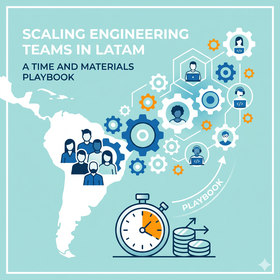
Strategic guide for scaling engineering teams in LATAM with time and materials model.

Scaling Engineering Teams in LATAM: A Time and Materials Playbook

For product and technology leaders in highly competitive markets, execution speed is the ultimate differentiator between staying relevant and becoming obsolete. However, local recruitment is often slow and prohibitively expensive, creating significant bottlenecks in the product roadmap. In this landscape, the scaling engineering teams in LATAM: a time and materials playbook emerges as the preferred solution for companies seeking high-quality talent, cultural affinity, and an efficient cost structure.

The Latin American region has evolved from being a "low-cost" option into a strategic hub for global innovation. The central question we address in this analysis is: how can companies implement a scaling engineering teams in LATAM: a time and materials playbook to optimize product delivery and cost efficiency? Understanding the mechanics of this model is vital for scaling without losing control over code quality or team cohesion.

Approaching scaling from a strategic perspective allows B2B, Fintech, and Insurtech organizations to adapt to unforeseen changes in demand without the rigidity of fixed-price contracts. Below, we break down the necessary tactics to ensure this transition becomes an operational and financial success.

Read entry
Senior development team collaborating on a high-scale digital product under a Time and Materials model.

Why the Best Developers Prefer Time and Materials over Fixed Price

In the world of high-stakes digital product development, the choice of engagement model is far more than a financial detail; it is a fundamental driver of project health and final output quality. For product leaders, CX directors, and CTOs, understanding why the best developers prefer Time and Materials over Fixed Price is essential for attracting and retaining the caliber of talent required to build resilient, market-leading solutions.

Fixed Price contracts often promise a sense of security through a locked-in budget and scope. However, for senior engineers and specialized agencies, this rigidity often creates a conflict of interest that pits profitability against technical excellence. In contrast, the Time and Materials (T&M) model fosters a culture of transparency and continuous improvement, allowing teams to focus on solving the right problems rather than just ticking off boxes in an outdated requirement document.

This article explores how the T&M model aligns the incentives of the business with those of the creators. We will examine the hidden costs of fixed scopes—such as technical debt and lack of innovation—and how a flexible approach allows organizations to leverage the full expertise of their partners to drive real business value in an ever-changing landscape.

Read entry
Remote stand-up management strategies in Time and Materials models for product leaders.

How to Manage Remote Stand-ups in Time and Materials Frameworks: Efficiency and Transparency

Effective remote stand-up management has become the operational nerve center for companies hiring technology and design services under the Time and Materials model. In an environment where every minute invested translates directly into an operating cost, the efficiency of these sessions is not just a matter of agility; it is a matter of financial health and mutual trust between client and provider.

The problem lies in the fact that, without a clear structure, daily meetings in distributed teams often degrade into micro-management sessions or endless status reports that dilute the value of the strategic profile. For product and technology leaders in sectors such as banking or insurance, understanding how to articulate these ceremonies is vital to ensuring that the flow of value does not stop due to communication friction.

How to optimize daily meetings in remote teams under a Time and Materials contract model to guarantee profitability and transparency? This post analyzes the tactics necessary to transform the daily session into an engine for visibility and cost control, ensuring that the investment in remote talent delivers measurable, high-quality results.

Read entry
Comparative chart of productivity and ROI across seniority levels in T&M projects.

The ROI of Senior LATAM Talent in Time and Materials Projects

The ROI of Senior LATAM talent is a critical factor in the management of technology projects and user experience design. Talent selection is often reduced to a simple comparison of hourly rates. Many organizations, pressured by quarterly budgets, opt for teams composed mostly of junior or mid-level profiles, assuming that lower operational costs automatically translate into savings. However, this vision ignores hidden frictions, reworks, and technical debt that emerge when execution lacks strategic depth.

The ROI of Senior LATAM talent is not measured solely by ticket delivery, but by the ability of these professionals to navigate ambiguity and optimize complex business processes. In regions like Latin America, the combination of cultural affinity, timezone overlap, and solid technical training creates a unique scenario for the Time and Materials (T&M) model, where senior efficiency becomes the primary driver of profitability.

Understanding the real question—What is the actual return on investment of hiring senior talent in Latin America under a Time and Materials model?—requires breaking down the impact of seniority on delivery speed, product quality, and risk reduction. In this article, we analyze why paying more per hour can, paradoxically, reduce the total cost of ownership of a digital product.

Read entry
Why 'Time and Materials' Supports Continuous Discovery in Agile

Why 'Time and Materials' Supports Continuous Discovery in Agile

In modern digital product development, uncertainty is not a bug in the system; it is an intrinsic feature of the market. Product and technology leaders often face the paradox of wanting innovative results while operating under rigid contractual structures. The "Fixed Price" model often promises budgetary security but frequently becomes a barrier to the adaptability and deep learning required by UX and true agility.

The success of a product does not depend on how faithfully a plan drawn up six months ago was followed, but on how quickly the team was able to pivot upon discovering that user needs had changed. This is where the relationship between the hiring model and the work methodology becomes critical. Continuous Discovery is not a phase, but a habit, and it requires an environment that does not punish change.

This article addresses the central question: Why is the Time and Materials (T&M) contract model the natural ally for implementing Continuous Discovery in Agile projects? We will explore how this financial structure allows organizations in banking, insurance, and fintech to transition from delivering features to delivering real value, minimizing waste and maximizing competitive relevance.

Read entry
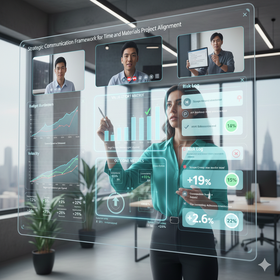
Strategic communication framework for Time and Materials project alignment.

Mastering Strategic Communication in Time and Materials Projects: A Guide for Product Leaders

In the complex landscape of digital product development, the Time and Materials (T&M) model has become the gold standard for projects requiring high levels of innovation and flexibility. Unlike fixed-price contracts, T&M allows for the evolution of requirements based on user research and market shifts. However, this flexibility introduces a significant challenge: the need for constant, high-fidelity communication to manage expectations regarding budget, timeline, and value.

For leaders in product, CX, and technology, the shift to T&M is not just a contractual change—it is a cultural one. Without a robust communication framework, the "open-ended" nature of these projects can lead to stakeholder anxiety, perceived lack of progress, and budget friction. The success of a T&M engagement relies less on rigid milestones and more on the continuous demonstration of progress and strategic alignment.

The central question facing modern delivery teams is: How can we transform communication from a status update into a strategic tool that justifies investment and ensures product excellence in a variable scope environment? Understanding the nuances of this dynamic is essential for maintaining healthy partnerships and delivering products that actually solve user problems.

Read entry