D Why the Best Developers Prefer Time and Materials over Fixed Price
Por Redacción Aguayo
In the world of high-stakes digital product development, the choice of engagement model is far more than a financial detail; it is a fundamental driver of project health and final output quality. For product leaders, CX directors, and CTOs, understanding why the best developers prefer Time and Materials over Fixed Price is essential for attracting and retaining the caliber of talent required to build resilient, market-leading solutions.
Fixed Price contracts often promise a sense of security through a locked-in budget and scope. However, for senior engineers and specialized agencies, this rigidity often creates a conflict of interest that pits profitability against technical excellence. In contrast, the Time and Materials (T&M) model fosters a culture of transparency and continuous improvement, allowing teams to focus on solving the right problems rather than just ticking off boxes in an outdated requirement document.
This article explores how the T&M model aligns the incentives of the business with those of the creators. We will examine the hidden costs of fixed scopes—such as technical debt and lack of innovation—and how a flexible approach allows organizations to leverage the full expertise of their partners to drive real business value in an ever-changing landscape.

Bridging the Gap Between Uncertainty and Engineering Mastery
The primary reason why the best developers prefer Time and Materials over Fixed Price is that it allows them to prioritize technical integrity and product-market fit over arbitrary contractual constraints. T&M eliminates the adversarial dynamic where a developer must choose between a project's financial margin and the quality of the code, creating a partnership based on shared goals.
- Adaptability: It enables teams to pivot based on user feedback or market shifts without constant legal renegotiations.
- Engineering Excellence: Developers can take the time to implement best practices, such as automated testing and refactoring, which are often cut in Fixed Price models to save costs.
- Risk Reduction: It avoids the "padding" of estimates common in Fixed Price, ensuring the client pays only for the value actually delivered.
- Collaboration: It positions the developer as a strategic partner rather than a mere vendor, fostering a shared commitment to the product's success.
To truly grasp the dynamics of modern engineering, one must accept that software development is an exercise in managing complexity and discovery. Unlike traditional manufacturing, the path from a business requirement to a functional, scalable feature is rarely a straight line. Senior developers understand this inherent uncertainty, which is why they gravitate toward models that respect the reality of the craft.
At Aguayo, we have consistently seen that when high-level talent is forced into the "straitjacket" of a Fixed Price contract, the first thing to suffer is innovation. When every hour spent exploring a better architectural solution or fixing a hidden vulnerability is seen as a loss against a fixed budget, the incentive shifts from "doing it right" to "doing it fast enough to be compliant." This is the antithesis of what top-tier developers strive for.
Transitioning to a Time and Materials mindset is not about avoiding accountability; it is about embracing a more sophisticated form of it. It requires moving from a culture of "outputs" (what was built) to a culture of "outcomes" (how it solved the problem). For the most skilled engineers, the ability to iterate and refine based on evidence is the only way to guarantee that the final product will actually perform in the wild.
Moving Beyond the Illusion of Control: A Strategic Mindset Shift
The Fixed Price Trap: A Zero-Sum Game for Innovation
The Fixed Price model relies on the flawed assumption that all requirements can be known at the beginning of a project. For a senior developer, this creates a defensive environment. If a technical challenge arises—as it always does in complex systems—the developer is penalized for the time it takes to solve it correctly. This often leads to "cutting corners" to preserve the margin, resulting in a product that may meet the initial spec but fails under load or becomes a nightmare to maintain.
This dynamic creates a "vendor vs. client" relationship. The client wants as much as possible for the fixed amount, while the vendor wants to do as little as possible to fulfill the contract. This lack of alignment is precisely why the best developers prefer Time and Materials over Fixed Price, as they want their interests to be perfectly synchronized with the long-term success of the product.
The Time and Materials Philosophy: Building on Trust and Transparency
In a Time and Materials engagement, the developer acts as a consultant and a craftsman. If they discover an opportunity to improve the user experience or a way to optimize the database for future scale, they have the professional freedom to advocate for that improvement. In this model, transparency is the currency. The client sees exactly where the effort is going, and the developer feels empowered to provide the highest level of value.
At Aguayo, we leverage this model to ensure that our UX and tech experts are not inhibited by obsolete scope documents. We have found that this approach leads to much higher levels of engagement and pride in the work. When developers are compensated for their actual effort, they are incentivized to provide the best possible advice, even if that means suggesting a different path than the one originally envisioned.
Prioritizing Evidence: Technical Integrity vs. Contractual Limits
The Hidden Price of Rigidity in Digital Products
In sectors like banking and insurance, the cost of failure is high. When a project is managed under a Fixed Price contract, "Scope Creep" becomes the enemy. This leads to endless change-order meetings and a bureaucratic overhead that drains the energy of the creative team. High-level developers, who thrive on problem-solving and "flow," find this environment stifling and counterproductive to speed and quality.
Under the T&M model, the scope is dynamic and evidence-based. We use real-world data—user testing, performance metrics, and competitive analysis—to determine what to build next. This ensures that the budget is always allocated to the features that will move the needle for the business. This lean approach is a core reason why the best developers prefer Time and Materials over Fixed Price; it keeps the work relevant and high-impact.
Managing Technical Debt as a Strategic Choice
One of the most significant technical reasons experts prefer Time and Materials is the management of technical debt. In Fixed Price models, when a deadline looms and the budget is nearly exhausted, testing and code quality are usually the first things to be sacrificed. This creates a "debt" that the client will eventually have to pay for in the form of bugs, downtime, and slow development cycles in the future.
Top-tier developers take pride in the longevity of their code. They prefer T&M because it allows for "continuous refactoring" and robust automated testing as part of the standard workflow. They know that a clean, well-architected codebase is an asset that grows in value, whereas a rushed, Fixed Price solution is a liability that starts depreciating the moment it is deployed.
The Developer as a Strategic Partner: Culture and Governance
Speaking the Language of Value Over Cost
The success of a Time and Materials model requires a high degree of organizational maturity. It is not a "blank check," but rather a governance framework based on radical transparency. The best developers prefer this model because it demands honesty. Instead of hiding a technical hurdle to avoid a contract dispute, the team can say: "This part is more complex than we thought; here are three ways to handle it and the trade-offs for each."
At Aguayo, we have seen that this level of communication transforms the relationship from a transactional one to a strategic partnership. It allows the client to make informed decisions about their investment in real-time. Developers are no longer just "order takers"; they are active participants in the business strategy, which is deeply rewarding for senior talent.
Cross-Functional Collaboration and Agility in Banking and Fintech
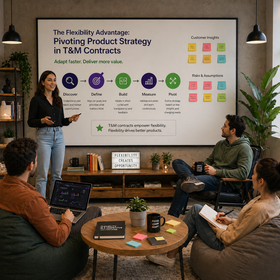
In highly regulated industries, the ability to pivot is a competitive advantage. Changes in regulation or shifts in user behavior can render a fixed scope obsolete overnight. The T&M model facilitates seamless collaboration between Aguayo’s UX, marketing, and tech teams and the client’s internal stakeholders. There are no contractual barriers to adjusting the UI or integrating a new API if the business environment changes.
This agility is a magnet for top talent. Developers want to work on products that succeed in the real world, not just projects that are delivered "on time" but are dead on arrival because they couldn't adapt to the market. By choosing T&M, organizations signal that they value the expertise of their team and are committed to building something that truly matters.
Frequently Asked Questions About Time and Materials vs Fixed Price
Why is Time and Materials better for innovation? Innovation requires experimentation and the freedom to fail or pivot. Fixed Price models penalize exploration, whereas T&M rewards finding the most efficient and effective solution based on real-time feedback.
Is Fixed Price safer for my budget? Not necessarily. Fixed Price contracts often include a "risk premium" of 30% to 50% to cover unknowns. Furthermore, "change orders" for items outside the initial scope can quickly inflate the final cost beyond what a T&M project would have been.
How do I control costs in a Time and Materials engagement? Cost control is achieved through rigorous agile management: setting clear milestones, conducting weekly budget reviews (burn rate), and constantly re-prioritizing the backlog so that only high-value items are developed.
Why do senior developers avoid Fixed Price projects? Experienced developers know that these projects often lead to high-stress environments where quality is sacrificed for compliance. They prefer the transparency and quality-focus that T&M provides.
What model does Aguayo recommend for digital product development? For any project involving complexity or innovation, Aguayo recommends Time and Materials. It ensures that the team’s incentives are aligned with the client’s long-term business goals and technical health.
Conclusion: Embracing a Culture of Continuous Value Delivery
The shift toward understanding why the best developers prefer Time and Materials over Fixed Price marks a turning point in how a company views its technological future. By prioritizing flexibility, transparency, and engineering mastery, organizations do not just build better software; they create an environment that attracts the brightest minds in the industry. The real risk in the digital economy is not the uncertainty of a flexible budget, but the certainty of delivering a product that fails to meet the quality standards or the shifting needs of the modern user.
Implementing this model requires a foundation of trust and a commitment to visibility, which we at Aguayo consider the cornerstone of every successful consulting engagement. When product and tech leaders realize that software is a living asset rather than a static commodity, the T&M model becomes the only logical choice for maintaining a competitive edge. It is an invitation to stop managing the fear of change and start managing the opportunities that change provides to exceed market expectations and business objectives.
Organizations that cling to rigid procurement models for complex problems will inevitably face talent attrition and the slow decay of their digital infrastructure. The path to digital maturity demands the courage to choose working models that reward intellectual honesty and technical craftsmanship over the false security of a legal document. Ultimately, the success of a digital product is measured by its ability to scale, adapt, and delight users—goals that are only fully attainable when the development team has the freedom and the support to do the job right the first time.