D Mastering Strategic Communication in Time and Materials Projects: A Guide for Product Leaders
Por Redacción Aguayo
In the complex landscape of digital product development, the Time and Materials (T&M) model has become the gold standard for projects requiring high levels of innovation and flexibility. Unlike fixed-price contracts, T&M allows for the evolution of requirements based on user research and market shifts. However, this flexibility introduces a significant challenge: the need for constant, high-fidelity communication to manage expectations regarding budget, timeline, and value.
For leaders in product, CX, and technology, the shift to T&M is not just a contractual change—it is a cultural one. Without a robust communication framework, the "open-ended" nature of these projects can lead to stakeholder anxiety, perceived lack of progress, and budget friction. The success of a T&M engagement relies less on rigid milestones and more on the continuous demonstration of progress and strategic alignment.
The central question facing modern delivery teams is: How can we transform communication from a status update into a strategic tool that justifies investment and ensures product excellence in a variable scope environment? Understanding the nuances of this dynamic is essential for maintaining healthy partnerships and delivering products that actually solve user problems.

Synchronizing Vision with Variable Velocity
Quick Response: Effective T&M Communication
To communicate effectively in Time and Materials projects, leaders must prioritize radical transparency, value-based reporting, and proactive expectation management. Instead of tracking hours in isolation, communication should focus on how those hours translate into validated product outcomes and risk reduction.
- Establish a Shared Definition of Value: Define what success looks like beyond mere feature completion.
- Maintain Real-Time Visibility: Use dashboards and frequent syncs to keep stakeholders informed of the current burn rate vs. progress.
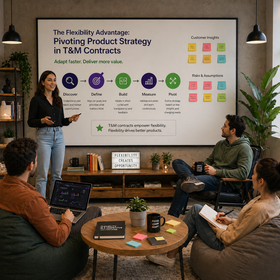
- Pivot Narratives: Focus on "What we learned and how it changes the path forward" rather than just "What we did."
- Manage Scope Proactively: Use trade-off discussions to ensure the budget is always allocated to the highest-impact tasks.
- Build a Trust-Based Culture: Transition from a vendor-client relationship to a unified team working toward a common goal.
The transition from fixed-scope thinking to a Time and Materials mindset requires a fundamental shift in how we narrative the development journey. In traditional models, communication is often binary—either a milestone is met or it isn't. In the fluid world of T&M, communication must act as the connective tissue that holds a pivoting strategy together. It is about creating a shared reality where the uncertainty of the scope is balanced by the certainty of the process and the expertise of the team.
When we approach T&M projects at Aguayo, we have found that the most successful outcomes stem from treating the budget as a finite fuel source for a journey, rather than a price tag for a destination. This requires leaders to be comfortable with ambiguity while being incredibly precise about the value being generated at every turn. It means moving away from "protecting the plan" and toward "optimizing the investment."
1. From Transactional Reporting to Strategic Storytelling
In a Time and Materials project, the "what" (the tasks completed) is often less important to stakeholders than the "why" (the strategic intent). Many teams fail because they provide laundry lists of completed JIRA tickets without context. To lead strategically, you must shift from reporting activities to narrating progress.
The Tactical Approach: Reporting Hours Tactical communication focuses on inputs. It answers the question, "How many hours did the UX researcher work this week?" While necessary for billing, this information does little to build confidence in the product's direction. In high-stakes environments like banking or insurance, this lack of context can trigger "audit-mode" thinking in stakeholders.
The Strategic Approach: Demonstrating Evolution Strategic communication focuses on outputs and outcomes. It explains how a week of UX research uncovered a critical friction point in the onboarding flow, leading to a pivot that will likely increase conversion by a significant margin. At Aguayo, we emphasize that in T&M, you aren't just buying time; you are buying the team's ability to navigate complexity and reduce waste by making informed decisions.
The UX in the Boardroom When communicating with executive leadership, the conversation should center on risk mitigation. T&M allows for early testing and validation, which prevents the massive financial waste of building the "wrong" thing. By framing T&M as a mechanism for capital efficiency, product leaders can align UX activities with the CFO's goals.
2. Radical Transparency as a De-risking Mechanism
The biggest fear stakeholders have in T&M projects is the "black box" effect—the feeling that money is being spent without a clear understanding of the trajectory. Radical transparency is the only antidote to this anxiety.
Focus on the Problem, Not the Solution One of the most effective communication strategies is to keep the focus on the problem being solved. When the scope needs to change—which it inevitably will in a T&M project—it is much easier to justify if the team has consistently communicated the complexity of the problem. If everyone agrees that "reducing churn in the mobile app" is the priority, then spending more time on deep UX audits becomes a logical strategic choice rather than an "extra" cost.
Prioritizing Impact vs. Effort In T&M, the product leader acts as a portfolio manager of the budget. Communication should frequently involve "Trade-off Workshops." For example: "With our current burn rate, we can either build Feature A with a high level of polish or Features B and C with a MVP approach. Based on our user data, Feature A offers 3x the potential ROI. Do we agree to focus there?" This keeps the client/stakeholder in the driver's seat of the investment.
The Voice of the Client as a Compass Using direct quotes from user testing or data from CX dashboards provides an objective third party to the conversation. It moves the discussion away from "I think we should do this" to "The users are telling us this is the barrier." This evidence-based communication is crucial in T&M because it provides the "why" behind the consumption of materials (hours/resources).
3. Collaboration and Governance: The Unified Team Model
The most successful T&M projects are those where the boundary between the "agency" and the "client" blurs. This requires a communication infrastructure that supports constant collaboration rather than gatekeeping.
Speaking the Language of Business UX and tech leaders must translate their work into business impact. Instead of talking about "heuristic evaluations," talk about "identifying usability barriers that delay time-to-market." Instead of "refactoring code," talk about "increasing system scalability to handle the projected 20% growth in user load."
Interdepartmental Alignment T&M projects often involve multiple stakeholders—Marketing wants features, Tech wants stability, and Product wants speed. The communication strategy must include a "Single Source of Truth," usually a live-updated roadmap or project dashboard that tracks:
- Budget Burndown: Current spend vs. total estimated budget.
- Velocity: How much "value" the team is delivering per sprint.
- Risk Log: Potential blockers that could impact future costs.
The Facilitator of Change In our experience at Aguayo, we’ve seen that T&M projects often fail not because of technical incompetence, but because of "organizational friction." The product leader must act as a facilitator, ensuring that the insights gained during the project are communicated across the organization. If the UX team finds a systemic issue in how the company handles insurance claims, that insight is a "material" that adds value far beyond the digital product itself.
Practical Examples in High-Stakes Industries
Case Study: Fintech Onboarding
A fintech company utilized a T&M model to redesign its complex KYC (Know Your Customer) process. Initially, the scope was just "UI cleanup." However, early UX research indicated that the friction was actually in the back-end API response times.
Communication Pivot: Instead of blindly following the UI task list, the team communicated: "We are shifting 40 hours of UI design to Technical Architecture to solve the API bottleneck. This will delay the final mockups by a week but will ensure the final product doesn't lose 40% of users at the first step."
Result: The stakeholder approved the change because the communication was proactive and focused on the end-user outcome (conversion) rather than the original contract line item.
Case Study: B2B SaaS Platform
In a B2B environment, a T&M project was struggling with "feature creep" from the sales department.
Communication Pivot: The Product Lead implemented a "Value-Effort Matrix" in every weekly sync. Every new request was plotted against existing tasks. "Adding this custom reporting module will consume two weeks of development time. We can do it, but we will have to push the Dashboard launch to next month. Which provides more value for the Q3 goals?"
Result: By forcing a comparison of value, the team maintained a healthy burn rate and delivered the highest-priority features first.
FAQ: Communication in Time and Materials Projects
How do you prevent budget overruns in T&M projects? Preventing overruns requires a weekly review of the burn rate against the roadmap. You must communicate early when a task is proving more complex than anticipated, allowing stakeholders to either increase the budget or reduce the scope of other items.
How often should you provide updates in a T&M model? While daily standups are for the internal team, stakeholders should receive a high-level "Value Summary" weekly. This should include what was delivered, what was learned, the current budget status, and any identified risks for the coming weeks.
What is the best way to handle scope changes in T&M? Scope changes should be handled through a "trade-off" conversation. Since the contract is flexible, the focus isn't on a formal change order, but on an agreement of priority. Use data to show why the new scope is more valuable than the old one.
How do I build trust if we don't have a fixed delivery date? Trust is built through consistent, incremental delivery. Show working software or validated designs frequently. When stakeholders see high-quality output every two weeks, the anxiety over a "final date" decreases because they see the value being created in real-time.
What metrics should I report in a Time and Materials engagement? Focus on Velocity (how much work is getting done), Cycle Time (how fast a feature goes from idea to "Done"), and most importantly, Outcome Metrics (e.g., reduction in user errors, increase in sign-up speed) rather than just hours logged.
Conclusion: Sustaining Momentum Through Strategic Transparency
The true power of a Time and Materials engagement lies in its agility but that agility is only as effective as the communication that directs it. To lead these projects successfully, you must abandon the comfort of rigid plans and embrace the responsibility of continuous alignment. At Aguayo, we have learned that trust is not a static state achieved at the signing of a contract; it is a living entity that must be fed daily. By prioritizing transparency and focusing on value over inputs, you turn the uncertainty of a variable scope into a competitive advantage.
This approach allows your team to pivot when the market shifts and to double down on features that demonstrate clear user resonance. Product leaders who master this narrative style find that their budgets are no longer viewed as "costs" but as strategic investments in growth. The risks of failing to communicate in this manner are significant. Without clarity, stakeholders default to a mindset of scarcity and fear. They begin to question every hour logged and every design iteration. This friction slows down development and kills the creative spirit. Ultimately, the goal is to create a partnership where the focus remains on building the most impactful product possible within the available means. In the sectors of banking, insurance, and fintech, where complexity is the norm, this level of strategic communication is not optional. It is the difference between a project that peters out and one that scales. We encourage you to look at your current reporting and ask yourself: "Am I telling my stakeholders what we did, or am I telling them why it matters?"
The answer to that question will determine the trajectory of your project. As you move forward, remember that your role is to be the navigator. The budget is the fuel, the team is the engine, and your communication is the map that ensures everyone reaches the destination together. By fostering a culture of radical honesty and evidence-based decisions, you ensure that the "materials" of your project—time, talent, and capital— are always spent on the things that move the needle for the business. Success in T&M is a marathon of alignment, not a sprint to a deadline. Stay focused on the problem, be transparent about the journey, and the results will eventually speak for themselves through a superior UX. This is the essence of strategic product leadership in the modern era.