Aguayo

D Interviews with Users and Focus Groups: Pros and Cons

Por Redacción Aguayo

Learn about the advantages that user interviews and focus groups offer in experience design, as well as their limitations.

antenna-cw-cj_nFa14-unsplash
CAPTION: Photo by Antenna on Unsplash

Introduction to User Interviews and Focus Groups

User interviews and focus groups are foundational pillars in the field of user research and user experience (UX) design. These methodologies empower designers and UX professionals to glean valuable insights directly from users, unlocking crucial insights that drive informed decision-making.

User Interviews:

User interviews provide fertile ground for understanding the needs, expectations, and challenges of users firsthand. Immersing in one-on-one conversations, researchers can delve into individual experiences and capture details that might go unnoticed in a broader context. These personalized interactions help build empathy, an essential component for designing products and services that authentically address user problems.

Focus Groups:

On the other hand, focus groups offer the opportunity to observe group dynamics and how users interact with each other. This collective approach can unveil patterns of thinking, social behaviors, and shared perceptions. By bringing together a group of participants, researchers can gain a broader perspective on user preferences and assess how ideas develop in an interactive setting.

Advantages and Challenges:

Both methods have their own advantages and challenges. In-depth interviews can provide rich, specific data but are often time and resource-intensive. On the flip side, focus groups are efficient in gathering diverse opinions but may be prone to the influence of group dynamics.

In this in-depth exploration, we will thoroughly analyze the advantages, challenges, and best practices of user interviews and focus groups. Additionally, we will examine how these methods can be strategically combined to offer a holistic understanding of user needs and expectations.

Benefits of User Interviews

User interviews, being a direct and personalized method, offer a range of key benefits in the product and service design and development process.

Deepening Understanding:

Interviews allow for a deep dive into users' experiences, perceptions, and expectations. By establishing an open dialogue, researchers can capture specific details crucial for understanding individual needs.

Empathy Building:

Understanding users' personal stories and challenges fosters empathy. This emotional component is vital for designing solutions that not only address surface-level issues but also resonate meaningfully with users' experiences and emotions.

Issue and Opportunity Identification:

Interviews highlight problems users may face with an existing product or service. Moreover, they reveal unexplored opportunities that could shape future innovation.

Design Personalization:

By gaining detailed insights, designers can tailor their approaches to meet specific user needs. This leads to the development of more effective, user-centric solutions.

Limitations of User Interviews

While user interviews are valuable, they also come with certain limitations that need to be considered in the research and design process.

Participant Subjectivity:

Information gathered in interviews may be influenced by participant subjectivity. Users may express opinions based on their individual perceptions, which may not necessarily reflect objective reality.

Researcher Bias:

Researcher bias is another factor to consider. The subjective interpretation of the researcher can influence the questions asked, the interpretation of responses, and decision-making based on the collected data.

Costs and Resources:

Conducting interviews can be costly and resource-intensive, especially when dealing with a large number of geographically dispersed participants. This may limit the ability to conduct comprehensive interviews.

Time and Logistics:

Coordinating time and logistics for interviews can be challenging, especially when working with participants with busy schedules. This can impact the availability and quality of the collected information.

Advantages of Focus Groups

Focus groups offer various advantages that make them a valuable tool for qualitative research.

Group Interaction:

Group dynamics in focus groups can generate interaction among participants. This interaction can reveal different perspectives, opinions, and experiences, enriching the quality of the collected data.

Idea Generation:

Focus groups are conducive to idea generation. By allowing participants to discuss and comment on a topic, it's possible to obtain innovative and creative insights that may not emerge in individual interviews.

Efficiency in Time and Costs:

Compared to individual interviews, focus groups can be more efficient in terms of time and costs. Bringing together multiple participants at the same time maximizes data collection in a single session.

Diversity of Perspectives:

The diversity of participants in a focus group can provide a broad range of perspectives. This diversity is especially useful when seeking to understand different user experiences with a product or service.

Disadvantages of Focus Groups

Despite their advantages, focus groups also present disadvantages that are crucial to consider.

Participant Dominance:

In some cases, group dynamics can result in the dominance of certain participants, silencing others. This can bias the results and limit the diversity of opinions represented.

Conformity Pressure:

Participants may feel pressure to conform to opinions expressed by the group, leading to responses influenced by the desire to please or fit in with the group.

Less Intimacy and Privacy:

Unlike individual interviews, focus groups offer less intimacy and privacy. Some participants may feel inhibited from sharing more personal opinions in a group setting.

Superficial Data Collection:

Due to the group nature, data collection in focus groups can be more superficial compared to more detailed individual interviews.

How to Successfully Integrate Interviews and Focus Groups into Your Design Strategy

The synergy between user interviews and focus groups can significantly enhance your design strategy. Here are some guidelines for successful integration:

Define Clear Objectives:

Before conducting interviews or focus groups, clearly define your research objectives. Are you looking to understand specific user needs or gain general insights? This clarity will guide your interactions.

Complement with Quantitative Methods:

Combine qualitative data from interviews and focus groups with quantitative methods. Surveys and statistical analysis can provide a more comprehensive perspective and support your qualitative findings.

Select Representative Participants:

Ensure you select participants who adequately represent your target audience. Diversity in experiences and perspectives will strengthen the validity of your results.

Facilitate Open Discussions:

During focus groups, encourage open discussions and prompt participants to express their opinions freely. A skilled moderator can create an environment conducive to valuable insights.

Integrate Results Holistically:

When analyzing data, look for patterns and convergences between findings from interviews and focus groups. This holistic integration provides a deeper and more balanced understanding.

Striking the Balance between User Interviews and Focus Groups

At the crossroads of user interviews and focus groups, the key lies in finding a balance that aligns with your objectives and specific context. Both methods offer unique benefits and inherent challenges.

Complementary Tools:

Both approaches can be powerful tools when used in conjunction. Interviews delve into individual experiences, while focus groups allow for collective exploration of ideas.

Context Consideration:

The choice between interviews and focus groups depends on the project context. For more specific issues, interviews can provide clarity, while focus groups are ideal for exploring collective perceptions.

Continuous Iteration:

User research is an iterative process. Don't be afraid to adjust your approach based on the changing needs of the project. Flexibility and adaptability are essential.

Holistic Integration:

True richness emerges when integrating data from both sources. Qualitative and quantitative information complement each other, providing a more complete and enriching view of the user experience.

Ultimately, success lies in deep understanding and empathy with users. By strategically balancing interviews and focus groups, you can unlock valuable insights that will inform and enrich your design process.
Thinking about working on a project? Write to us, and we'll help you out.

More blog

About work, workshops, creative processes, new clients, old clients, daily life, and UX, epistemological thoughts, and critiques.

scaling-engineering-teams-in-latam-time-and-materials-playbook

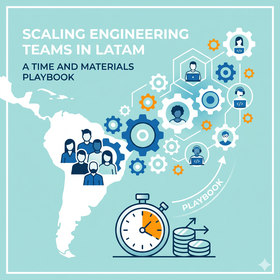
Scaling Engineering Teams in LATAM: A Time and Materials Playbook for Agile Growth

Scaling engineering teams in LATAM has evolved from a simple cost-reduction tactic into a strategic necessity for product organizations facing severe domestic talent shortages. However, many technology leaders struggle with volatile product roadmaps, prolonged onboarding timelines, and rigid contract structures that stifle innovation. Failing to align team expansion with flexible procurement models directly degrades engineering velocity and inflates technical debt. This playbook delivers a operational framework using Time and Materials (T&M) structures to build highly adaptable, high-performing engineering hubs in Latin America that integrate seamlessly with your core product operations.

Read entry
managing-sprint-cycles-time-and-materials-engagement-agile-dashboard

Managing Sprint Cycles in a Time and Materials Engagement: Maximizing ROI in Agile Consulting

Organizations shifting to Agile product development often struggle to balance budget predictability with operational flexibility when working with external partners. Managing Sprint Cycles in a Time and Materials Engagement presents a unique challenge: the open-ended nature of the billing model can easily lead to unchecked scope creep and financial bleeding if the product backlog is poorly governed. Without a rigid framework that links engineering hours directly to measurable product increments, businesses face escalating burn rates without guaranteed delivery. This article outlines the precise governance, prioritization, and tracking mechanisms required to maintain fiscal discipline while leveraging the creative freedom of adaptive sprint cycles

Read entry
time-and-materials-vs-outsourcing-talent-retention-chart

Time and Materials vs. Outsourcing retention analysis for product engineering teams

Managing talent continuity in external engineering teams directly impacts product velocity, code quality, and time-to-market. When analyzing Time and Materials vs. Outsourcing retention, product and technology leaders frequently encounter high turnover rates that disrupt sprint cycles and dilute institutional knowledge. Traditional fixed-price outsourcing often incentivizes vendors to optimize for margin over talent satisfaction, resulting in rolling churn that stalls complex product development. Choosing the wrong engagement model creates hidden financial friction, as engineering onboarding cycles consume valuable senior leadership resources and delay core roadmap deliverables.

Read entry
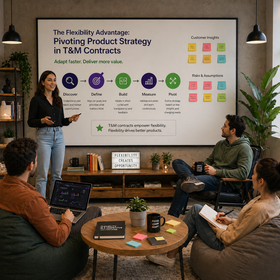
pivoting product strategy in T&M contracts

The Flexibility Advantage: Pivoting Product Strategy in T&M Contracts

In the high-stakes world of digital product development, the only constant is change. Traditional fixed-scope contracts often act as a straightjacket, preventing teams from responding to market shifts or user feedback discovered during the build. This is where the strategic advantage of Time and Materials (T&M) models becomes apparent, offering the structural freedom necessary for high-growth companies.

Pivoting product strategy in T&M contracts is not merely about changing direction; it is about leveraging financial and operational flexibility to maximize business value. For product leaders, CX directors, and CTOs, understanding how to navigate these pivots is the difference between a failed launch and a market-leading innovation.

This article explores the mechanics of successful strategic shifts within T&M frameworks. We will analyze how to maintain budget discipline while embracing the "pivot," ensuring that every hour billed translates into a tangible step toward product-market fit.

Read entry
Strategic guide for scaling engineering teams in LATAM with time and materials model.

Scaling Engineering Teams in LATAM: A Time and Materials Playbook

For product and technology leaders in highly competitive markets, execution speed is the ultimate differentiator between staying relevant and becoming obsolete. However, local recruitment is often slow and prohibitively expensive, creating significant bottlenecks in the product roadmap. In this landscape, the scaling engineering teams in LATAM: a time and materials playbook emerges as the preferred solution for companies seeking high-quality talent, cultural affinity, and an efficient cost structure.

The Latin American region has evolved from being a "low-cost" option into a strategic hub for global innovation. The central question we address in this analysis is: how can companies implement a scaling engineering teams in LATAM: a time and materials playbook to optimize product delivery and cost efficiency? Understanding the mechanics of this model is vital for scaling without losing control over code quality or team cohesion.

Approaching scaling from a strategic perspective allows B2B, Fintech, and Insurtech organizations to adapt to unforeseen changes in demand without the rigidity of fixed-price contracts. Below, we break down the necessary tactics to ensure this transition becomes an operational and financial success.

Read entry
Senior development team collaborating on a high-scale digital product under a Time and Materials model.

Why the Best Developers Prefer Time and Materials over Fixed Price

In the world of high-stakes digital product development, the choice of engagement model is far more than a financial detail; it is a fundamental driver of project health and final output quality. For product leaders, CX directors, and CTOs, understanding why the best developers prefer Time and Materials over Fixed Price is essential for attracting and retaining the caliber of talent required to build resilient, market-leading solutions.

Fixed Price contracts often promise a sense of security through a locked-in budget and scope. However, for senior engineers and specialized agencies, this rigidity often creates a conflict of interest that pits profitability against technical excellence. In contrast, the Time and Materials (T&M) model fosters a culture of transparency and continuous improvement, allowing teams to focus on solving the right problems rather than just ticking off boxes in an outdated requirement document.

This article explores how the T&M model aligns the incentives of the business with those of the creators. We will examine the hidden costs of fixed scopes—such as technical debt and lack of innovation—and how a flexible approach allows organizations to leverage the full expertise of their partners to drive real business value in an ever-changing landscape.

Read entry
Strategic framework for overcoming cultural barriers in LATAM-US remote collaborations.

Overcoming Cultural Barriers in LATAM-US Remote Collaborations

The shift toward nearshoring has positioned Latin America as the premier partner for US-based technology and design firms. However, many organizations discover that proximity in time zones does not automatically translate to proximity in workplace culture. The friction often arises not from technical inability, but from unaddressed systemic differences in communication, hierarchy, and feedback loops.

For product leaders, CX directors, and CTOs, the challenge of overcoming cultural barriers in LATAM-US remote collaborations is the "last mile" of digital efficiency. Without a deliberate strategy to bridge these gaps, projects face delays, reduced morale, and a lack of authentic innovation. This article explores the deep-seated cultural dimensions that influence these partnerships and provides a roadmap for high-performing, cross-border integration.

Read entry
Remote stand-up management strategies in Time and Materials models for product leaders.

How to Manage Remote Stand-ups in Time and Materials Frameworks: Efficiency and Transparency

Effective remote stand-up management has become the operational nerve center for companies hiring technology and design services under the Time and Materials model. In an environment where every minute invested translates directly into an operating cost, the efficiency of these sessions is not just a matter of agility; it is a matter of financial health and mutual trust between client and provider.

The problem lies in the fact that, without a clear structure, daily meetings in distributed teams often degrade into micro-management sessions or endless status reports that dilute the value of the strategic profile. For product and technology leaders in sectors such as banking or insurance, understanding how to articulate these ceremonies is vital to ensuring that the flow of value does not stop due to communication friction.

How to optimize daily meetings in remote teams under a Time and Materials contract model to guarantee profitability and transparency? This post analyzes the tactics necessary to transform the daily session into an engine for visibility and cost control, ensuring that the investment in remote talent delivers measurable, high-quality results.

Read entry
Comparative chart of productivity and ROI across seniority levels in T&M projects.

The ROI of Senior LATAM Talent in Time and Materials Projects

The ROI of Senior LATAM talent is a critical factor in the management of technology projects and user experience design. Talent selection is often reduced to a simple comparison of hourly rates. Many organizations, pressured by quarterly budgets, opt for teams composed mostly of junior or mid-level profiles, assuming that lower operational costs automatically translate into savings. However, this vision ignores hidden frictions, reworks, and technical debt that emerge when execution lacks strategic depth.

The ROI of Senior LATAM talent is not measured solely by ticket delivery, but by the ability of these professionals to navigate ambiguity and optimize complex business processes. In regions like Latin America, the combination of cultural affinity, timezone overlap, and solid technical training creates a unique scenario for the Time and Materials (T&M) model, where senior efficiency becomes the primary driver of profitability.

Understanding the real question—What is the actual return on investment of hiring senior talent in Latin America under a Time and Materials model?—requires breaking down the impact of seniority on delivery speed, product quality, and risk reduction. In this article, we analyze why paying more per hour can, paradoxically, reduce the total cost of ownership of a digital product.

Read entry
Why 'Time and Materials' Supports Continuous Discovery in Agile

Why 'Time and Materials' Supports Continuous Discovery in Agile

In modern digital product development, uncertainty is not a bug in the system; it is an intrinsic feature of the market. Product and technology leaders often face the paradox of wanting innovative results while operating under rigid contractual structures. The "Fixed Price" model often promises budgetary security but frequently becomes a barrier to the adaptability and deep learning required by UX and true agility.

The success of a product does not depend on how faithfully a plan drawn up six months ago was followed, but on how quickly the team was able to pivot upon discovering that user needs had changed. This is where the relationship between the hiring model and the work methodology becomes critical. Continuous Discovery is not a phase, but a habit, and it requires an environment that does not punish change.

This article addresses the central question: Why is the Time and Materials (T&M) contract model the natural ally for implementing Continuous Discovery in Agile projects? We will explore how this financial structure allows organizations in banking, insurance, and fintech to transition from delivering features to delivering real value, minimizing waste and maximizing competitive relevance.

Read entry