D User Experience: Televisa optimizes its website with Aguayo
Por Redacción Aguayo
Aguayo collaborated with various departments within the Televisa Group and Univision, a media conglomerate whose largest shareholder is Televisa, on the user experience (UX) centered redesign of Las Estrellas, Televisa Espectáculos, Televisa Noticias, and Canal 5. Furthermore, Aguayo also ventured into other projects for the Mexican company, such as the microsite for the 2018 FIFA World Cup and Fusión México, both also based on UX.

During the second semester of 2017 and the first of 2018, Aguayo collaborated with various departments including SEO, Technology, Editorial, Product Design, Product, Digital, Social, Sales, and the Creative Management at Univision. Their goal was to revamp Televisa's service portfolio around a new digital strategy focused on user satisfaction, platform growth and efficiency, as well as editorial and business needs.
Aguayo, alongside the Mexican company with a presence in different countries across the Americas, Europe, and North Africa, dedicated to the production and distribution of content through television channels, cable operators, and internet services, directed their efforts towards three main objectives:
- Strengthening a successful brand by integrating Las Estrellas, Televisa Espectáculos, and Estilo de Vida.
- Strengthening the Televisa brand and centralizing content with Las Estrellas, Noticias, and Deportes.
- Attracting new audiences for Canal 5.
These objectives were to be consolidated through actions based on User Experience (UX) and oriented towards research discovery, information design analysis, prototype experience design, visual design, requirement definition documents, final drawings or sketches, and brand prototype construction.
Sandra Merino, Senior Creative Director of UX/UI at Univision, expressed the need to work against a fragmented and disjointed user experience."
"Univision and Televisa formed a synergy between the teams in the United States and Mexico for the benefit of this transformation process. We hired Aguayo to provide the website with a new User Experience (UX) and Information Architecture (IA)."
Objectives Definition
It was established what Grupo Televisa desired. In the case of televisa.com, it was about unifying the channel offerings and serving as a gateway to each one.
Aguayo determined that the site should clearly showcase the content focus of each channel and provide a quick and efficient redirection to user-relevant content.
Another point was to offer a link to corporate content, to which Aguayo proposed valuable content and segmentation by type.
televisa.com. Televisa also has an interest in live entertainment, film production and distribution, as well as games and lotteries.
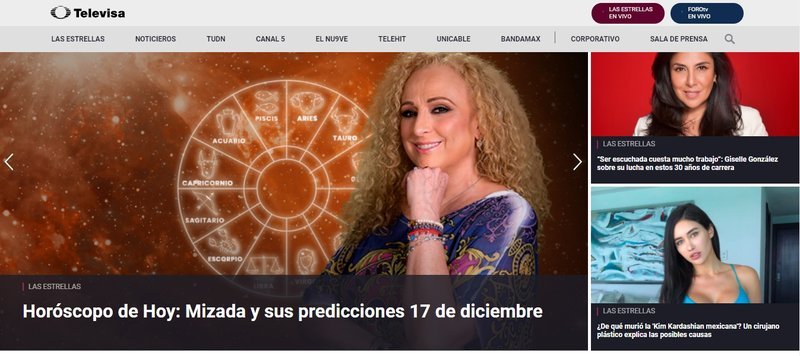
For Las Estrellas (formerly El Canal de las Estrellas), the television network with the highest audience ratings in Mexican territory, the following priorities were identified:
- Create a video-centric website.
- Project an image of entertainment beyond the television channel.
- Improve the performance of ad formats.
- Generate branded content.
- Attract an audience aged 18 to 35.
- Achieve longer user web engagement.
- Build user loyalty.
According to Aguayo, the leader in telenovelas, reality shows, celebrity news, and horoscopes, should respond to each of the above points as follows:
- Adapt to consumer trends and commercial needs.
- Expand the content offering and position itself in the users' minds as a general entertainment website.
- Increase the inventory of above-the-fold ads (the part of the web users see first), view times, and exposure.
- Recognize that results from branded content generation occur in the medium to long term.
- Emphasize social media channels to captivate a younger audience.
- Enhance performance, product, and encourage recirculation.
- Increase the percentage of recurring users.
lasestrellas.tv. Currently, this website features a main menu divided into categories such as soap operas, shows, reality programs, entertainment, lifestyle, and horoscopes.
KPI's Identification
The Key Performance Indicators, or KPIs, allowed for the association of web metrics with strategic objectives to facilitate their measurement and tracking.
For example, metrics such as the number of sessions redirected to Televisa, the time spent on the homepage, and the number of sessions redirected to corporate content were tracked. In the case of Las Estrellas, KPIs included the number of views for short videos, long videos, and live streaming broadcasts.
These KPIs provided valuable data to optimize performance and became the central axis for product and service quality, ultimately leading to user satisfaction
Interviews
In August 2017, Aguayo interviewed Televisa leaders Jose Raymundo Zamarripa, Farid de la Peña, Gustavo Torres, Clara Méndez, and Luis Soto in order to continue building the objectives. This User Experience (UX) research technique is typically conducted using questions such as:
- What is your history with the product, service, or organization?
- What tasks are performed with the product or service?
- What problems do you encounter?
- What do you like the most and what do you dislike the most?
- What applications or tools are used to achieve the objectives?
- How are they used?
- What are the results of those activities?
- What tasks are necessary to successfully complete the goals?
- What do you consider success in that context?
In Aguayo's agile and iterative development approach, it is essential that user research is conducted quickly, effectively, and with strictly necessary resources to avoid wasting time and costs.
External Benchmarking
The comparative analysis responded to organizations with products, services, and work processes ideal for achieving the objectives Televisa wanted to fulfill. Aguayo delivered a detailed study of the websites and evaluated the following aspects:
TMZ
tmz.com. An American website about celebrities. It was founded in 2005 by AOL and Telepictures Productions, both owned by Time Warner.
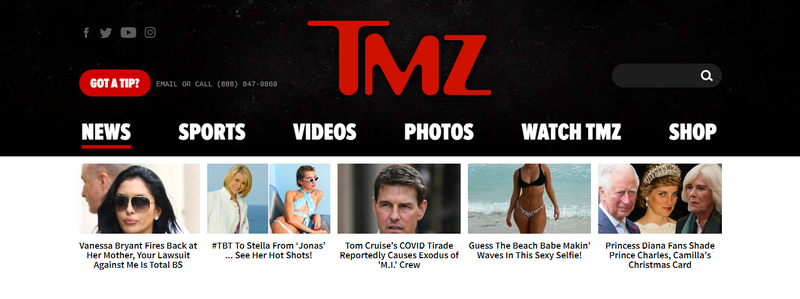
- Brand
- Site structure
- Advertising
- Video
- Social
- Mobile
- Special content
- Engagement
- Summary
People
people.com. An American magazine and website covering celebrities and general interest stories.
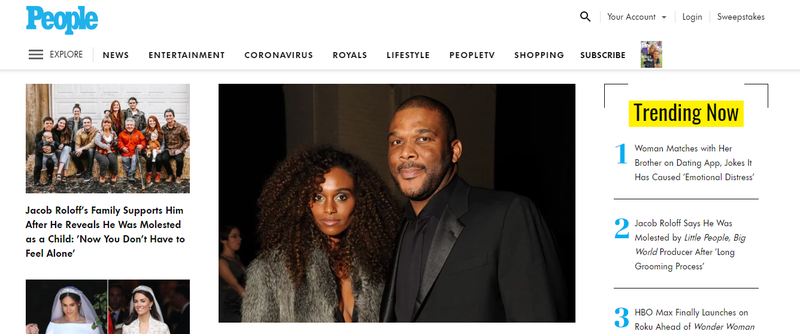
- Brand
- Site structure
- Advertising
- Video
- Social
- Mobile
- Summary
E! Entertainment
eonline.com. A television network and website focused on celebrities, television, and music.
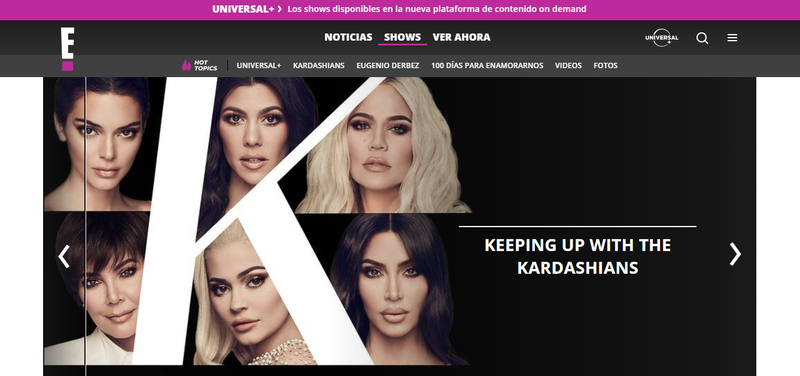
- Brand
- Site structure
- Advertising
- Video
- Social
- Mobile
- Special content
- Summary
Internal Benchmarking
Aguayo conducted web analytics for Las Estrellas, Espectáculos, and Canal 5, focusing on bounce rates, recurring visitors, traffic from desktop computers, mobile devices, and tablets, as well as interaction through social networks and email. Additionally, session recordings were performed, capturing specific actions of 12,505 anonymous users for Las Estrellas, 8,904 for Espectáculos, and 3,141 for Canal 5, with two main objectives:
- Observing navigation to identify behavioral patterns.
- Establishing differences in behavior between a recurring user and a sporadic one.
User Profiles
The research began with a survey installed on the Televisa website as a pop-up window, which users could voluntarily complete. More than 700 people participated, answering questions such as:
- What content are you looking for?
- What content would you like to find?
- How would you like that content to be?
After data collection, the information was analyzed, and searches were conducted on social media to learn more about the preferences and hobbies of the respondents. This information was combined with the results of the internal benchmark and categorized by age, occupation, city, key phrases, device used for access, visit frequency, average session time, key tasks, frustrations, and vocabulary.
The user profiles that were ultimately created for Televisa and Las Estrellas included:
- The millennial
- The centennial
- The young mother
- The wife
- The Mexican
- The independent individual
- The conqueror
- The expat"
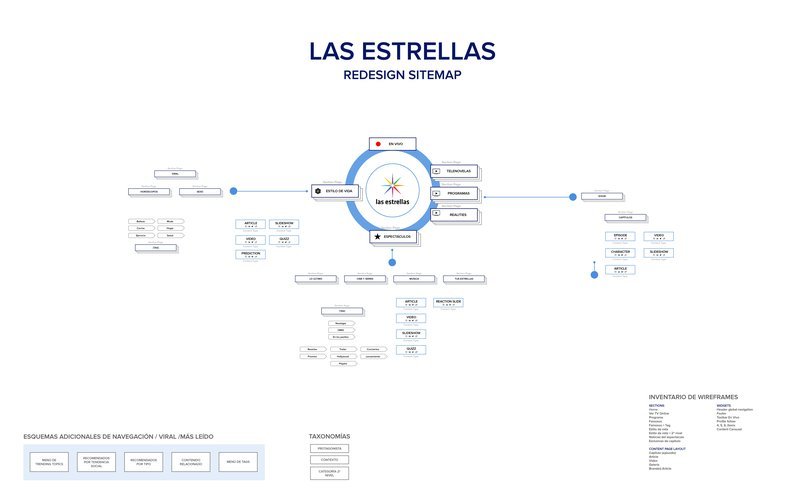
Wireframes & Sitemaps
The wireframe is a sketch, outline, tree structure, page architecture, among other terms, used to visually represent behavior, requirements, and content.
Aguayo created various wireframes for Grupo Televisa. Among them, approximately 20 were designed for Las Estrellas, divided into three categories:
Sections:
- Home.
- Watch TV online.
- Program.
- Celebrities.
- Celebrities > tag.
- Lifestyle.
- Lifestyle > second level.
- Entertainment news.
- Chapter exclusives.
Widgets:
- Header.
- Footer.
- Live toolbar.
- Content carousel.
- And others.
Content page design:
- Chapter (episode).
- Article.
- Video.
- Gallery.
- Branded article (brand articles).
Sitemaps or files listing URLs are crucial to inform search engines about which pages are available for indexing. Search engines like Google have high expectations when it comes to sitemaps:
Even if you use a sitemap, we cannot guarantee that we will crawl and index all the elements it includes, as our processes schedule crawls based on complex algorithms. However, in most cases, your website will benefit from having a sitemap, and it will not be negatively affected in any way.
Aguayo applied intelligent methods to this project, including complete and structured URLs, maximum size, canonical URLs, a version for mobile and desktop, and indications of content types such as videos, images, or news, among others.
Search Engine Optimization (SEO) was a central element in Aguayo's strategies, aimed at making it easier for search engines to understand and present the content effectively.
Aguayo. Las Estrellas is the most important and significant brand of Televisa, according to its YouTube channel.
UI Design
The User Interface Design phase of the project was solidified through Aguayo's deliveries. These deliveries ensured a good User Experience (UX) to guide navigation through techniques and guidelines based on best content practices and device accessibility in the market (desktop, tablets, smartphones, consoles, etc.).
Functionality, aesthetics, adaptability, and interactive behavior depended on the challenges posed by Aguayo:
- Making content the beginning and end of the experience.
- Ensuring content matches the user's consumption moment.
- Working on related content in line with user behavior.
- Creating a consistent design with clear starting points and calls to action (CTAs).
- Developing modular designs with reusable components.
- Providing a seamless experience by integrating scrolling and related content.
Televisa was looking for a modern, flexible design proposal that would present content, images, and their portfolio in an attractive manner.
The creative director added that there were special expectations regarding the technological aspect due to the migration to a new content management system.
A redesign of this nature didn't just involve making it look nicer or be user-friendly, but also ensuring that the pages in the behind-the-scenes had optimal construction for the new CMS, Brightspot.
After the implementation of the projects, led by Televisa, Televisa Digital compiled a report of the results. Las Estrellas, whose report dates from January 29 to February 11, 2018, showed overall growth, such as a 40% increase in page views, a 65% increase in video views, and a 30% increase in streaming. It also demonstrated a 116% faster loading time, a 91.2% decrease in errors, and a 47.5% increase in session duration.
Aguayo excelled in terms of procedures and vision. Furthermore, he adapted to the hybrid working model, where he couldn't be 100% autonomous. In this regard, I was surprised by how he had such a flexible team that was open to co-creation, factors that made a project of this nature and magnitude successful.
This is how Merino highlighted Aguayo's professionalism and pointed out that the objective was achieved in terms of User Experience (UX), Information Architecture (IA), look and feel, and technological implementation.
"The site was launched; it may seem obvious, but it isn't. Achieving in such large companies that a design product sees the light of day and is not radically rethought but preserves its essence is a triumph for the teams involved in planning and creation. Currently, many pieces that we created are in use. We built many interesting ideas with Aguayo that can be implemented in the future," he concluded.
Canal 5
televisa.com/canal5. On its Twitter account, it is presented as an open television channel that broadcasts cartoons, TV series, and reality shows.
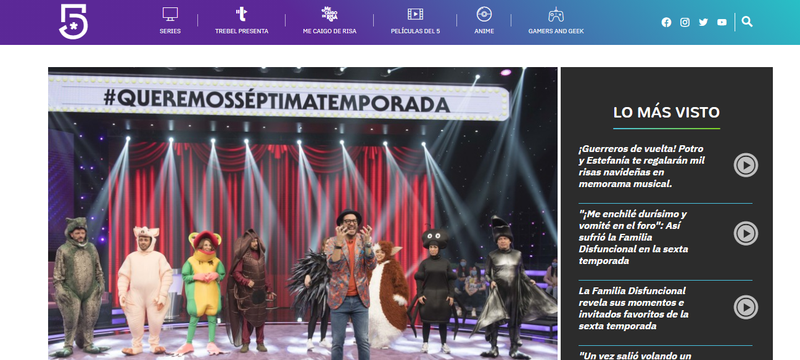
The Mexican television network is primarily targeted at children and teenagers with series from companies like Nickelodeon and Cartoon Network. For the general audience, it features productions from Paramount Network, FOX, Warner Bros., MTV, NBC Universal, and Univision.
Based on User Experience (UX), Aguayo played a role in defining objectives and content strategy for the Canal 5 website. To begin, he engaged with the management team to understand their interests, issues, and expectations using the KJ Method, also known as the Affinity Diagram, created by anthropologist Jiro Kawakita. This method helped identify and organize patterns in the participants' opinions and provided an overview of both negative and positive aspects related to services, stakeholders, audiences, technology, key operational and business processes impacted, and crucial interactions.
The information was visualized in word clouds, a technique used to graphically represent terms with the highest frequency. The size of each word is proportional to its frequency.
Aguayo. "Youthful" and "modern" were the words that were used most frequently to describe "what our users are like."

Aguayo. "Innovative" was the word that was used most frequently in response to "what we want people to say about Canal 5."

Subsequently, he conducted a prototyping exercise (sketching) to outline the main structural elements, finalize the concept, and synthesize the website's interface.
After the value definition workshop, Aguayo continued the process with the study of disruptive navigation patterns and a benchmark or comparison of websites whose products, services, and processes could serve as references.
Key Experience Principles
These, defined based on the contributions and feedback from the content and User Experience (UX) teams, were established to guide the Information Architecture (IA) process.
IA (Information Architecture) arranges and defines the informational and structural content of a website based on the audience's needs and preferences, aiming to ensure the final product's quality and complete user satisfaction.
These were the foundational principles of the objectives and KPIs (Key Performance Indicators):
First Objective
Provide a second screen experience that aligns with the TV channel's programming.
Its KPIs
- ↑ Mobile sessions.
- ↑ Sessions on real-time programming-related content.
Second Objective
Enhance content relevance for the audience and increase time spent on the site.
Its KPIs
- ↑ Time spent on the site.
- ↑ Number of pages viewed per session.
- ↑ Social reactions associated with content.
- ↓ Bounce rate.
Third Objective
Attract audiences between the ages of 18 and 34.
KPI
- ↑ Number of sessions in the 18 to 34 age segments.
Fourth Objective
Respond to the content consumption trends of the young audience.
Its KPIs
- ↑ Sessions from organic SEO.
- ↑ Sessions from social.
The implementation of Aguayo's plan for the Canal 5 website, which specializes in information and videos of series, programs, and movies, was entrusted to the Televisa Group.
FIFA World Cup Russia 2018
Sergey Petrov|Pixabay. Lokomotiv Stadium in the city of Nizhny Novgorod, Russia.

The Televisa Group contacted Aguayo once again to work on a microsite for the FIFA World Cup Russia 2018 based on User Experience (UX) and with the final result being the User Interface Design (UI).
The new challenges included:
- Ensuring that the functionalities were within the limits of individual rights agreements and FIFA's general rules and regulations on social and digital media.
- Integration with modules for latest matches, latest videos, rankings; sections for matches, videos, teams, and statistics; and team and player profile pages.
- Projecting for video widgets, video thumbnails, team widgets, team lists, teams, player bios, tournament statistics, match statistics, team statistics, team statistics summaries, team statistic details, and team comparisons.
At the end of the World Cup, Televisa Deportes reached an accumulated audience of over 184 million people in match broadcasts, according to its corporate website. It received the YouTube Gold Button after reaching one million subscribers and generating 150 million views. Additionally, it had a successful partnership with Facebook, founded on a daily live program and augmented reality.
Fusión Mexico
The Televisa Group involved Aguayo in this project to create a User Experience (UX)-centered design. The processes developed with Televisa members, including those at Fusion Mexico, included:
Empathy maps
Aguayo's team traveled to Mexico to conduct workshops.
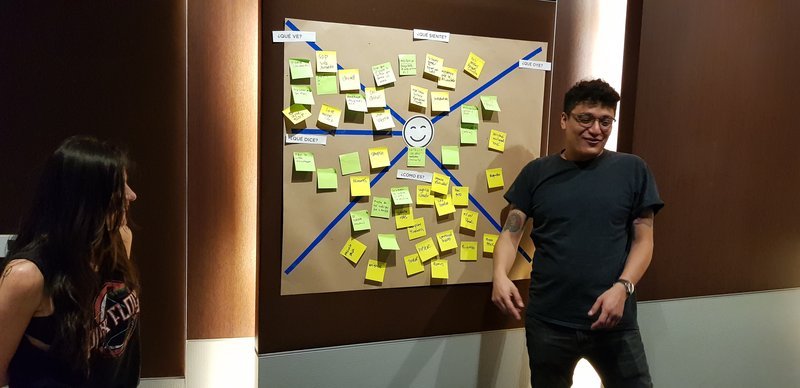
Aguayo. Workshops serve as models for teaching and learning.
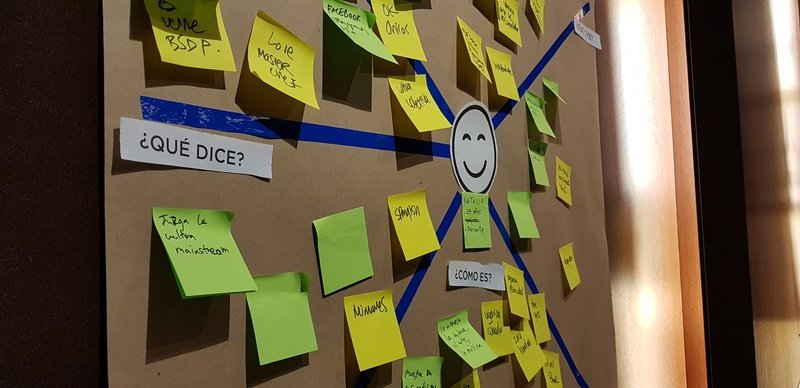
These were used to understand the interests and motivations of users by putting themselves in their shoes, based on five questions:
- What do they see?
- What do they say and do?
- What do they hear?
- What do they think?
- What do they feel?
Headlines War
Aguayo customizes activities around User Experience (UX) according to the audience and the project.
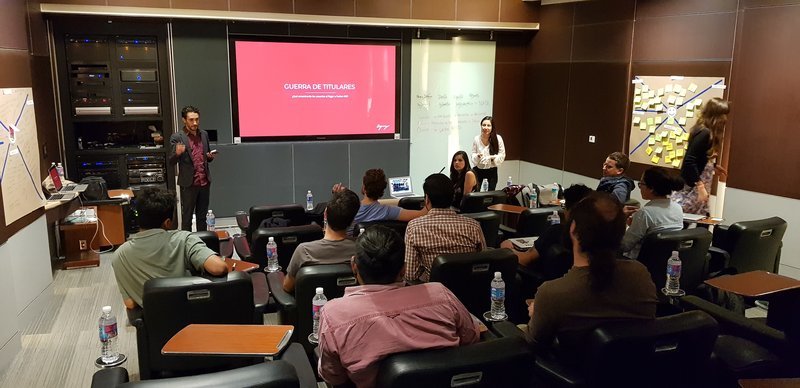
What will users find when they arrive at Fusión México? Thinking about headlines that would be on the front page and captivate the audience led Televisa members to materialize their conception of the site in terms of content. The team with the most headlines written in three minutes won the competition.
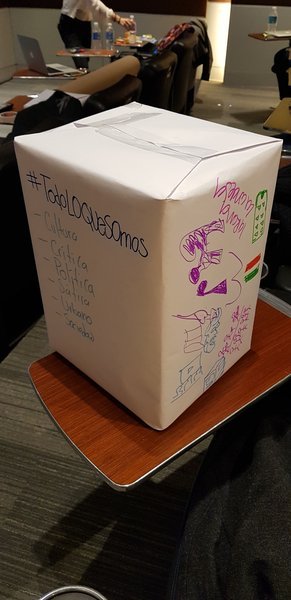
Pack Design
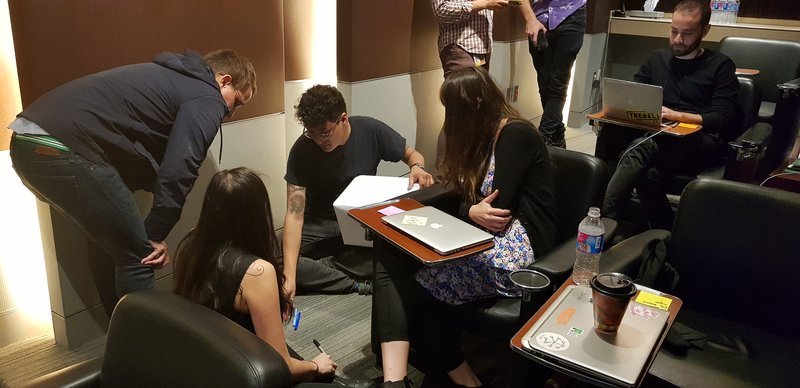
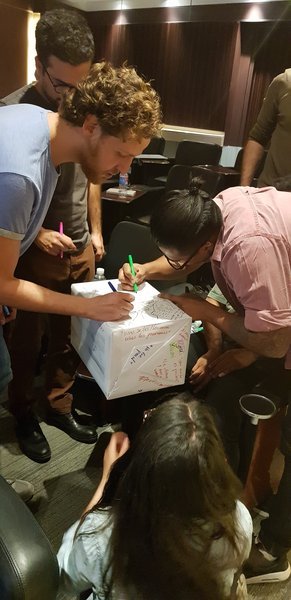
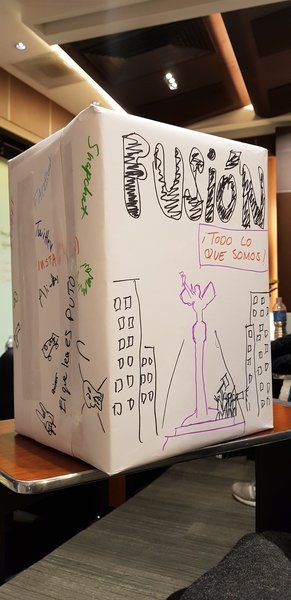
The intention of this activity was to identify the value of the digital product and align it with user needs. In 15 minutes, participants simulated a production process for the product and service and synthesized their ideas. Having physical constraints on the packaging forced them to clarify the information.
Aguayo. Creation of ideal proposals for a user profile.
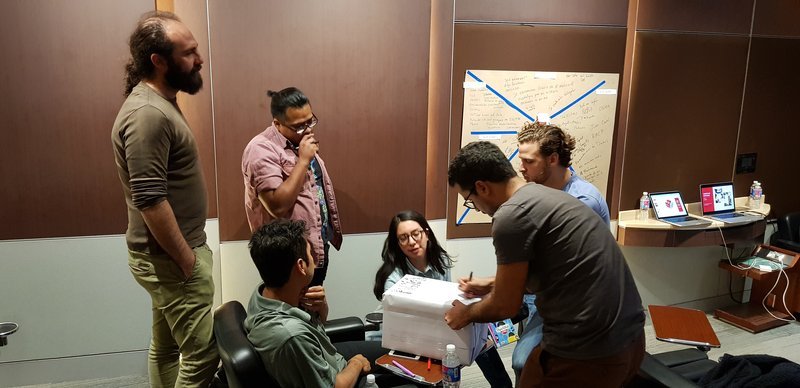
Aguayo. Resorting to symbolic attributes.
Aguayo. Highlighted differential elements.
Aguayo. Contribution to a distinctive positioning.
Aguayo. Communicative tool with value.
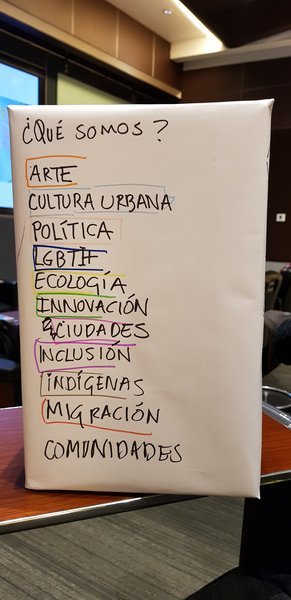
Aguayo. Key messages to convey.
External Benchmark
Aguayo. The evaluation of peer sites, references, or competitors is key in researching navigation and content proposals. For Fusion, Aguayo selected portals with audiences and formats similar to those mentioned by Televisa members in previous practices.
These included Vice, Playground, AJ+, Medium, Cultura Colectiva, and Fusion TV.
User Profiles
They were based on men and women between 21 and 29 years old who consume Netflix, memes, Youtube, documentaries, modern art, and social networks. They are also interested in politics and investigative journalism. They demand quality in stories and share good content.
Objectives & KPIs
With the previous points clarified, six objectives were established, each with its respective Key Performance Indicators (KPIs), which are used to measure and track the specified purposes.
Key Performance Indicators (KPIs) can vary in types, including financial, economic, logistics, production, human resources, quality assurance, customer-related, service, and support, among others.
First Objective
Create a captive and loyal audience for the brand.
KPIs
- ↑ Number of followers on social media.
- ↑ Number of recurring users.
Second Objective
Attract millennial and centennial audiences between the ages of 18 and 34.
KPI
- ↑ Number of sessions in the 18 to 34 age segments.
Third Objective
Ensure the quality and relevance of content for the audience.
KPIs
- ↑ Time spent on the site.
- ↑ Number of pages viewed per session.
Fourth Objective
Use organic traffic acquisition sources in line with user consumption trends.
KPIs
- ↑ Sessions from organic SEO.
- ↑ Sessions from social media.
Fifth Objective
Adapt to users' multi-device consumption habits.
KPIs
- ↑ Multi-device users.
- ↑ Sessions during peak TV channel hours.
Sixth Objective
Provide an experience that complements what will be created on the pay TV channel.
KPI
- ↑ Sessions consuming content generated by the digital editorial team.
The implementation of Fusión México, like that of Las Estrellas, Canal 5, and the Russia 2018 World Cup mini-site, was carried out by the Televisa Group.
Source
- Juan David Saab Vanegas, former Director of UX at Aguayo.
- Irene Blanco Serrano, former Director of Projects at Aguayo.
- Documents from the Televisa Group.
- Documents from Univision.
- Documents from Aguayo.
- Documents from joint collaboration between the Televisa Group, Univision, and Aguayo.
- Corporate website of the Televisa Group.
- Press releases from the Televisa Group.