D What is the PURE Method for Usability Evaluation of a Digital Product?
Por Redacción Aguayo
In the fast-paced world of digital design, where user experience stands as an undeniable cornerstone, usability evaluation methodologies become crucial tools. Among these, the PURE Method (Pragmatic Usability Rating by Experts) stands out, a creation of the renowned Jakob Nielsen, a pioneer in usability discipline. This pragmatic approach has revolutionized the way we evaluate the interaction between users and digital products.

Introduction to the PURE Method
Origins and Foundations
The PURE Method has its roots in the need to simplify and make usability evaluation processes more effective. Nielsen, recognized for his contributions to user-centered design, conceived this method as a response to the inherent complexity of other evaluation techniques. His goal was to create a methodology that, while robust in its analysis, was more accessible and applicable in varied contexts.
The term "pragmatic" encapsulates the essence of the PURE Method. It is based on the premise of obtaining meaningful results with the least complexity possible. Instead of delving into detailed metrics, the pragmatic approach seeks to evaluate the usability of a product in a practical and effective manner, providing actionable information for the design team.
Key Principles
The PURE Method is governed by key principles that distinguish it in the usability evaluation landscape. Instead of relying exclusively on quantitative metrics, such as task times and success rates, it focuses on the quality of interaction. The evaluation is carried out through the expert eyes of usability professionals who apply their experience and knowledge to rate the usability of the product.
Simplicity is another fundamental principle. The PURE Method does not require extensive user testing sessions. Instead, it focuses on expert evaluation, streamlining the process and allowing for quick and repeatable assessments. This feature makes it particularly valuable in environments where resources and time are limited.
Adaptability and Practical Application
One of the most prominent strengths of the PURE Method is its adaptability to various stages of the development cycle. It can be applied at different moments, from the initial design phases to advanced iterations. Its flexibility makes it a valuable tool for teams looking to integrate usability evaluation continuously throughout the development process.
The application of the PURE Method involves the participation of usability experts, who analyze the product in question from various perspectives. They assess the clarity of the interface, the efficiency in task performance, and overall user satisfaction. These evaluations translate into pragmatic ratings that offer a holistic view of the product's usability.
Advantages and Challenges
The PURE Method presents several advantages that position it as an attractive choice in the world of digital design. Its pragmatic and expert-focused approach facilitates the integration of usability evaluations into teams with limited resources. The speed at which it can be implemented allows for valuable feedback in early stages of development, avoiding costly corrections in advanced phases.
However, like any method, PURE is not without challenges. The inherent subjectivity in expert evaluation can introduce variability in results. The quality of evaluations depends largely on the experience and knowledge of the experts involved. Additionally, while the PURE Method offers a pragmatic evaluation, it may lack the depth that certain projects require, especially those focused on the user experience.
Basic Principles of the PURE Method
At the core of the PURE Method lies a distinctive set of fundamental principles that shape its pragmatic approach and its ability to effectively evaluate the usability of digital products. These principles are the backbone that guides usability experts in their assessments, providing a clear framework for understanding the interaction between users and digital systems.
- Evaluation Based on Interaction Quality: The PURE Method departs from conventional quantitative metrics and delves into the quality of interaction. Instead of focusing solely on task efficiency, it orients towards how users experience the interface and their ability to perform actions intuitively. This principle recognizes that usability goes beyond execution speed and focuses on the overall user experience.
- Pragmatic Approach and Simplification: Simplicity is essential in the PURE Method. This pragmatic approach seeks to obtain meaningful results with the least complexity possible. Instead of complicated metrics, the ability of experts to issue pragmatic ratings based on their experience and knowledge is valued. This simplicity not only accelerates the evaluation process but also facilitates the interpretation of results.
- Usability Expert Evaluation: A fundamental pillar of the PURE Method is evaluation by usability experts. These professionals, with a solid background in user-centered design, apply their knowledge to rate the usability of a product. Their expert perspective adds depth to the assessment, considering aspects beyond the superficial and capturing crucial elements for the user experience.
- Adaptability to Different Contexts: The PURE Method stands out for its adaptability to various stages of the development cycle. It can be applied in early design phases, when concepts are still taking shape, as well as in more advanced iterations. This flexibility allows for continuous integration of usability evaluation throughout the development process, ensuring that products evolve with user needs and expectations.
- Focus on Accessibility and Action: The pragmatic evaluation of the PURE Method not only identifies areas for improvement but also focuses on accessibility and action. The results not only inform about potential issues but also offer clear guidance for action. This aligns with the method's philosophy of not only being a critical observer but also a driver of tangible and practical improvements.
- Agility and Speed: Speed is a distinctive feature of the PURE Method. By focusing on expert evaluation and simplifying the process, this method enables rapid feedback. This is particularly valuable in environments where deadlines are tight, and agile decisions are required to improve usability in real-time.
Steps to Implement the PURE Method
The PURE Method stands out for its pragmatic approach and its ability to provide quick and actionable evaluations of the usability of a digital product. Here we present the key steps to implement this method, using an evaluation scale that incorporates color codes to indicate the perceived cognitive load by users.
- Material Preparation:
- Collect and prepare the necessary materials, including interactive prototypes and usage scenarios.
- Ensure that usability experts have access to all relevant information about the product.
- Expert Evaluation:
- Gather a group of qualified usability experts.
- Provide experts with the necessary materials and set expectations for the evaluation.
- Product Interaction:
- Allow experts to interact with the digital product according to provided scenarios.
- Record experts' observations and perceptions during interaction.
- Application of the Evaluation Scale:
- Use an evaluation scale that employs color codes to indicate the perceived cognitive load by users.
- Assign points based on the perceived difficulty in performing specific tasks.
- Green (1 point): Low cognitive load, the user performs the task easily.
- Yellow (2 points): Significant cognitive load. The user must make some effort.
- Red (3 points): High cognitive load. The user gives up the task.
- Results Collection and Analysis:
- Collect the results of the evaluation from each expert.
- Conduct a comparative analysis of scores and observations.
- Recommendation Generation:
- Based on the results, generate specific recommendations to improve the usability of the product.
- Prioritize recommendations based on the severity of identified issues.
- Feedback and Adjustments:
- Provide detailed feedback to the design and development team.
- Make adjustments to the product based on recommendations to address identified issues.
- Iteration or Validation:
- If necessary, iterate the evaluation process after making adjustments.
- Validate the effectiveness of implemented improvements through additional testing.
Example of the PURE Method
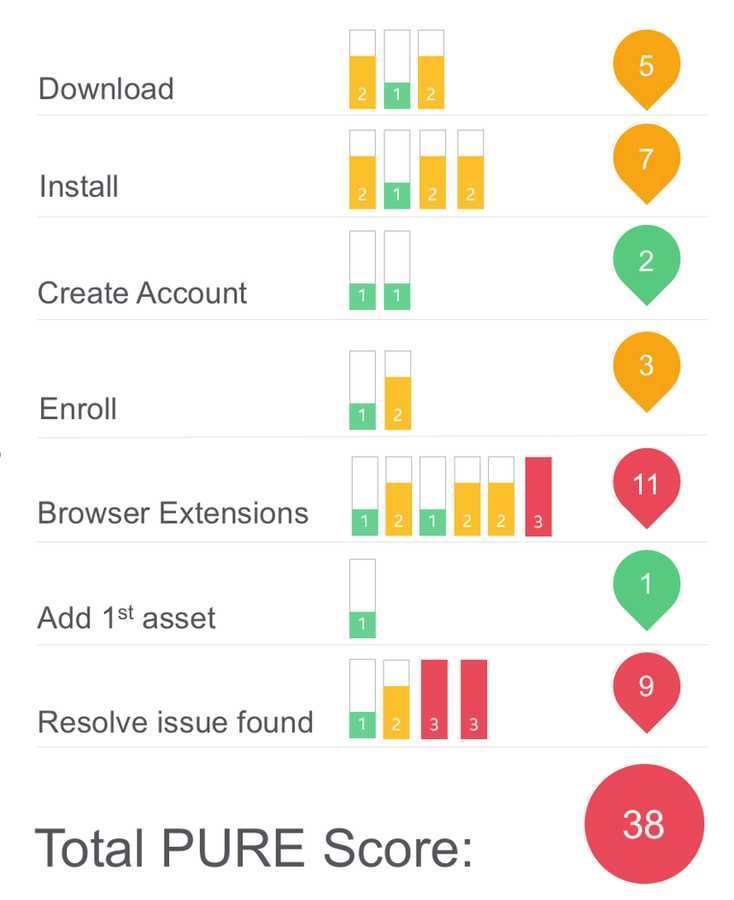
Tools Used in the PURE Method
The effective implementation of the PURE Method depends not only on the expertise of evaluators but also on the right tools that facilitate the evaluation and analysis process. These tools contribute to the efficiency and accuracy of the assessment, allowing experts to focus on the quality of interaction and obtain meaningful results. Below, we highlight the tools commonly used in the PURE Method.
- Prototyping and Design Software: The use of prototyping and design software is crucial in the materials preparation phase. Tools like Sketch, Figma, or Adobe XD allow the creation of interactive prototypes that evaluators can use during the assessment. These prototypes serve as visual representations of the product and facilitate the understanding of the interface by usability experts.
- Session Recording Platforms: During expert evaluation, capturing interactions between users and the product is valuable. Session recording platforms, such as UsabilityHub or Lookback, allow recording the actions of evaluators and provide a detailed view of how users interact with the interface. These recordings become invaluable material for later analysis.
- Online Collaboration Tools: Collaboration among evaluators is essential to ensure a comprehensive and objective evaluation. Online collaboration tools, such as Miro or InVision, allow evaluators to share observations, comments, and ratings synchronously. They facilitate effective communication among the team, improving the consistency and quality of evaluations.
- Structured Rating Scales: To translate qualitative evaluation into quantifiable results, structured rating scales are used. These scales, ranging from numerical scores to descriptive categories, allow evaluators to assign consistent and comparable ratings to different aspects of usability. Establishing a clear scale is crucial for consistency in evaluation.
- Data Analysis Platforms: After collecting results, data analysis platforms are used to examine patterns and trends. Tools like Excel, Tableau, or even usability-specific analysis tools provide functionalities to visualize and better understand the collected data. These analyses inform design decisions and guide corrective actions.
- Surveys and Additional Feedback: Complementing expert evaluation, surveys and additional user feedback can offer valuable insights. Tools like SurveyMonkey or Google Forms allow the creation and distribution of surveys addressing specific aspects of the user experience. Integrating the user's voice in the process strengthens the overall usability assessment.
Comparison with Other Usability Evaluation Methods
The choice of a usability evaluation method largely depends on the project goals, the scope of the evaluation, and available resources. When comparing the PURE Method with other common approaches, we can highlight key differences that make PURE stand out in certain contexts.
- Expert Evaluation vs. User Testing: In contrast to methods that rely primarily on user testing, the PURE Method focuses on evaluation conducted by usability experts. While user testing involves real participants interacting with the product, PURE depends on the experience and knowledge of professionals to assess usability. This makes PURE agile and suitable for situations where resources or time for user testing are limited.
- Simplicity vs. Detailed Metrics: Unlike approaches that focus on detailed metrics and extensive testing, the PURE Method embraces simplicity. Instead of delving into complex quantitative data, it relies on pragmatic evaluations by experts. This makes it particularly effective in environments where quick decision-making and immediate feedback are priorities.
- Flexibility in the Development Cycle: The PURE Method stands out for its adaptability to different stages of the digital product development lifecycle. It can be applied in both the initial design phases and more advanced iterations. This flexibility sets it apart from methods that may be more focused on specific stages of the development cycle.
- Pragmatic Approach and Immediate Action: The pragmatic approach of the PURE Method translates into the ability to deliver actionable results quickly. While some methods may require time for extensive analysis, PURE enables immediate feedback that can drive improvements in design and usability in an agile manner.
- Subjectivity Controlled by Experience: Although expert evaluation introduces a degree of subjectivity, this subjectivity is controlled by the experience and deep knowledge of the evaluators. Other methods that rely more on direct user feedback may face similar challenges in terms of subjective variability, but with PURE, the quality of the evaluation depends directly on the competence of the experts involved.
Conclusion and Future Perspectives
The adoption of the PURE Method in the usability evaluation of digital products offers substantial benefits but also raises opportunities for future explorations and improvements. In this section, we summarize key conclusions and consider possible directions for the ongoing development of this approach.
Achievements of the PURE Method
The PURE Method has proven to be an agile and effective tool for evaluating the usability of digital products. Its pragmatic approach, centered on expert evaluation, enables quick and actionable feedback. Notable achievements of PURE include:
- Agility and Efficiency: The simplicity of the PURE Method makes it especially agile, allowing for quick and efficient evaluations.
- Adaptability to Different Stages: The flexibility of PURE to adapt to various stages of the development lifecycle makes it easily integrable into ongoing projects.
- Action-Oriented Focus: Immediate feedback and a focus on practical improvements make PURE valuable for quick decision-making.
Challenges and Areas for Improvement
Despite its successes, the PURE Method faces challenges that deserve ongoing attention:
- Controlled Subjectivity: Expert evaluation introduces controlled subjectivity, but careful management of this aspect remains essential.
- Integration of User Voice: The lack of direct user participation in the evaluation highlights the importance of integrating perspectives from real users complementarily.
- Continuous Validation: Continuous validation of the PURE Method through comparisons with other methods and adjustments based on feedback will enhance its robustness and applicability.
Future Perspectives
To advance the development of the PURE Method, various directions can be explored:
- Integration of Quantitative Data: Explore ways to complement the qualitative evaluation of PURE with quantitative data for a more comprehensive understanding.
- Incorporation of Emerging Technologies: Evaluate how emerging technologies, such as artificial intelligence, can enhance or complement usability evaluation.
- Validation in Different Contexts: Conduct additional validations in diverse contexts and with digital products from different industries to improve the generalization of results.
- Development of Associated Tools: Explore the development of specific tools that support and enhance the application of the PURE Method.
In conclusion, the PURE Method stands out as a valuable tool for usability evaluation, especially in environments where agility and immediate feedback are required. As it evolves, its integration with complementary approaches and the ongoing consideration of real user perspectives will solidify its position as a robust and effective methodology.