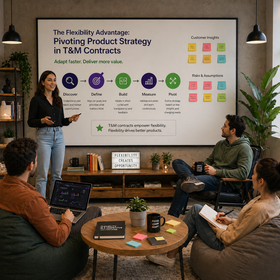
D Time and Materials Contracts: Managing Risk Effectively
Por Redacción Aguayo
In the landscape of digital product development, the contract model chosen between a client and a partner is rarely just a financial formality; it is a structural determinant of the project's success or failure. For leaders in banking, insurance, and technology, the tension is palpable: Procurement departments traditionally favor the perceived certainty of Fixed Price contracts, while product and technology teams require the flexibility of Time and Materials (T&M) to execute true Agile methodologies. The conflict arises from a fundamental misunderstanding of where risk actually lies in software development.
While Fixed Price models promise cost certainty, they often result in rigid scope adherence that stifles innovation and incentivizes vendors to cut corners to protect margins. Conversely, Time and Materials models align incentives toward quality and adaptability but introduce the fear of the "blank check"—an open-ended commitment with no guaranteed ceiling. This fear often drives organizations back to rigid contracts that are ill-suited for the complexity of modern user experience (UX) and technical challenges.
The central question for leadership is not which model eliminates risk—because no model can—but rather how to manage that risk intelligently. How can an organization embrace the flexibility of T&M to build superior products while maintaining the fiscal discipline and accountability required by the boardroom? This article explores the strategic governance, mindset shifts, and operational frameworks necessary to turn T&M contracts from a financial liability into a competitive advantage.

Setting the Stage for Collaborative Excellence: Beyond the Rate Card
Managing risk in Time and Materials (T&M) contracts requires shifting from controlling the scope to controlling the process and budget velocity. Instead of locking down requirements upfront, organizations manage risk by establishing strict governance, transparency, and collaborative prioritization.
Key Strategies for Success:
- Implement "Not to Exceed" (NTE) Caps: Set budget ceilings that trigger reviews before further spending is authorized.
- Focus on Outcome, Not Output: Measure success by business value delivered (KPIs), not just hours worked.
- Empower Product Owners: Give internal POs the authority to prioritize the backlog, ensuring money is spent only on high-value features.
- Track Velocity and Burn Rate: Use real-time data to forecast completion dates and budget consumption, allowing for early course correction.
- Establish Short Sprints: Review deliverables every two weeks to ensure alignment and quality, allowing you to "fail fast" or pivot without wasting months of budget.
- Build Trust Through Transparency: Require partners to provide detailed logs of hours and impediments, creating a "glass box" workflow.
Beyond the Illusion of Certainty
For decades, the standard for purchasing services—from construction to manufacturing—was the Fixed Price contract. It offered a comforting equation: $X amount of money equals Y deliverable by Z date. However, applying this industrial logic to intellectual and creative work, such as UX design and software engineering, creates a dangerous illusion of certainty. In the volatile markets of Latin America and the global tech sector, user needs change, regulations shift, and competitors pivot. A contract that penalizes change is a contract that penalizes adaptation.
The transition to Time and Materials is often viewed by procurement as a loss of control. In reality, it is the acquisition of a different kind of control. It moves the organization from a passive state—waiting until the end of a project to see if the "black box" delivers—to an active state of continuous steering. This section explores the historical context of this friction and sets the stage for a new operational standard where financial risk is managed through visibility rather than rigidity.
From Tactical Contracting to Strategic Partnership
1. The Mindset Shift: Contract vs. Collaboration
To manage T&M effectively, leaders must first dismantle the "vendor vs. client" adversarial dynamic inherent in Fixed Price thinking.
The Tactical Trap: The Fixed Price Fallacy In a Fixed Price model, the vendor assumes the financial risk. If the project takes longer than expected, the vendor loses money. Consequently, the vendor is incentivized to:
- Limit scope aggressively (resisting improvements).
- Assign lower-cost, less experienced talent to protect margins.
- Hide problems until it is too late to fix them without penalty.
- Focus on "checking the box" of the requirement rather than solving the user's problem.
The Strategic Approach: Shared Risk and Reward in T&M In T&M, the client assumes the risk of efficiency, but gains the power of direction. The vendor is incentivized to:
- Demonstrate value constantly to justify continued engagement.
- Provide their best talent to ensure efficiency.
- Raise red flags early, as they are not penalized for uncovering complexity.
The Boardroom Narrative When selling T&M to stakeholders, the narrative must shift from "we don't know how much it will cost" to "we have full control to stop or pivot spending at any moment." In Aguayo’s experience with banking and insurance clients, framing T&M as an "investment portfolio" rather than a "purchase order" helps. You are funding a team to solve a problem, and you review the ROI of that team every two weeks.
2. Prioritizing the Essential: Governance as the Safety Net
The biggest risk in T&M is not the hourly rate, but the lack of prioritization which leads to "zombie projects" that consume budget without delivering value.
Focus on the Problem, Not the Feature List In T&M, the backlog is living. Risk is managed by ruthlessly prioritizing the backlog based on business value.
- MoSCoW Method: Must have, Should have, Could have, Won't have.
- WSJF (Weighted Shortest Job First): A prioritization model used in SAFe (Scaled Agile Framework) to calculate the cost of delay.
The Role of the Empowered Product Owner The single most effective risk mitigation tool in a T&M contract is a competent internal Product Owner (PO). The PO acts as the gatekeeper of the budget.
- The PO's Duty: They decide what the development team works on next. If the PO ensures the team is always working on the highest-value item, the risk of wasted budget drops to near zero.
- The Check-and-Balance: If the external team burns 100 hours, those hours must correspond to features the PO explicitly authorized.
Data-Driven Decision Making Risk management in T&M relies on evidence, not estimates.
- Burn-down Charts: Visual representations of work left to do versus time.
- Velocity Tracking: Measuring exactly how many "points" or units of work a team delivers per sprint.
- Budget Burn Rate: A weekly report showing exactly how much capital has been consumed and forecasting the "runway" remaining.
Table: Governance Mechanisms for T&M Risk Control
Communication and Collaboration: The "One Team" Model
For T&M to work, the barrier between "internal employee" and "external vendor" must dissolve. The external team must operate with the same context and care as internal staff.
Transparency as a Non-Negotiable At Aguayo, we have observed that T&M contracts fail when transparency is low. Effective T&M requires a "Glass Box" approach:
- Access to Tools: The client should have access to the vendor’s Jira, Trello, or Azure DevOps boards. Nothing should be hidden.
- Detailed Timesheets: Logs should not just say "Development - 8 hours." They should say "Refactoring login API to reduce latency - 8 hours."
- Impediment Reporting: The vendor must report immediately if they are blocked by the client (e.g., waiting for API keys or legal approval). In T&M, waiting time is billable, so identifying bottlenecks is a shared financial responsibility.
The "Stop Switch" Clause To comfort procurement teams, T&M contracts should always include a termination for convenience clause with a short notice period (e.g., 2 weeks). This is the ultimate risk mitigation: if the team stops delivering value, the client can cut funding immediately. This is far easier than litigating a breach of contract in a Fixed Price engagement.
Cultural Integration High-performing T&M teams require psychological safety. If the external developers feel they will be fired for making a mistake or estimating incorrectly, they will revert to "Fixed Price behavior"—padding estimates and hiding truths. Leaders must foster a culture where bad news is delivered early so it can be managed.
Managing Scope Creep vs. Scope Discovery There is a difference between "creep" (adding unnecessary features) and "discovery" (realizing the original plan was wrong). T&M allows for discovery. The governance structure ensures that when new scope is discovered, something less important is removed from the backlog to maintain the budget cap. This is the "Trade-off Conversation," and it is the heart of strategic product management.
Implementation in Regulated Industries In sectors like Banking and Fintech, where compliance is strict, T&M can seem daunting. However, T&M allows for compliance requirements to be integrated into the Definition of Done (DoD) for every sprint, ensuring that regulatory risk is managed incrementally rather than inspected in a panic at the end of the project.
Frequently Asked Questions about Time and Materials Contracts
The shift toward nearshoring in LATAM has democratized access to world-class technical talent, presenting an unparalleled opportunity for organizations seeking flexibility and velocity through the Time and Materials model. However, the true value of a LATAM T&M partnership is not realized in the initial contract signing, but in the day-to-day execution that elevates the engagement from transactional task delivery to strategic co-creation. We have meticulously explored the triad of non-negotiable success factors: strategic alignment, robust governance, and cultural integration. A partner that exhibits Strategic UX/UI Maturity views the T&M hours not as a commodity to be spent, but as capital to be invested in continuous user discovery and high-impact feature validation. They proactively challenge the status quo, advocating for solutions that are rooted in quantifiable data—be it through A/B testing results, usability metrics, or business ROI projections. This is the litmus test that separates the mere implementer from the genuine product contributor.
The Governance Framework must be watertight, characterized by hyper-transparency in time tracking, granular effort allocation (distinguishing design, research, and coding hours), and a disciplined prioritization process that ruthlessly focuses on high-impact, low-effort wins. This prevents the dreaded "scope drift" and ensures every dollar spent contributes measurably to the intended business outcome. Finally, the often-underestimated factor of Cultural and Communication Fluidity underpins the entire operation. The best LATAM partners act as cultural interpreters, ensuring feedback is clear, intentions are understood, and the development team feels a true sense of ownership over the client's product vision. Their low attrition rate and investment in their team’s professional development—from advanced design certifications to domain-specific knowledge—become your project’s most potent risk mitigation strategy. Ultimately, the decision to choose a T&M partner in LATAM is a declaration of commitment to a collaborative, iterative future. By selecting a firm that sees itself as a strategic partner, a co-creator, and a champion of the user experience, you are not just acquiring talent; you are securing a competitive edge in the volatile, fast-paced world of digital product development. Choose wisely, prioritize the strategic over the tactical, and prepare for a rewarding journey of co-creation that delivers exceptional value, sprint after sprint. The success of your digital product hinges on this pivotal decision.
Conclusion: Building Trust Through Transparency
The transition from Fixed Price to Time and Materials is not merely a change in billing; it represents a maturation in how an organization values digital creation. It acknowledges that software development is a journey of discovery, not a manufacturing line, and that the greatest risks are not financial overruns, but irrelevance and poor quality. By shifting the focus from negotiating penalties to managing velocity, leaders gain the ability to steer products in real-time, adapting to user feedback and market shifts with agility.
This model demands a higher caliber of leadership—one that is involved, data-driven, and capable of making hard prioritization decisions based on evidence rather than speculation. However, this involvement is the very mechanism that reduces risk; instead of hoping a vendor delivers months from now, you verify value every two weeks. Implementing caps, empowering Product Owners, and demanding radical transparency turn the vendor relationship into a true strategic partnership. The risk of inaction—of sticking to rigid contracts that deliver obsolete software—is far greater than the managed risk of variable billing. Ultimately, T&M provides the framework for honesty, where problems are solved collaboratively rather than hidden behind contract clauses. It aligns the incentives of the client and the partner toward the only metric that truly matters: the successful, high-quality delivery of a product that users love. When governance is strong and trust is established, the "blank check" fear disappears, replaced by a dynamic engine of continuous value delivery. The organizations that master this balance will not only save money in the long run but will build cultures capable of sustained innovation.