D Why 'Time and Materials' Supports Continuous Discovery in Agile
Por Redacción Aguayo
In modern digital product development, uncertainty is not a bug in the system; it is an intrinsic feature of the market. Product and technology leaders often face the paradox of wanting innovative results while operating under rigid contractual structures. The "Fixed Price" model often promises budgetary security but frequently becomes a barrier to the adaptability and deep learning required by UX and true agility.
The success of a product does not depend on how faithfully a plan drawn up six months ago was followed, but on how quickly the team was able to pivot upon discovering that user needs had changed. This is where the relationship between the hiring model and the work methodology becomes critical. Continuous Discovery is not a phase, but a habit, and it requires an environment that does not punish change.
This article addresses the central question: Why is the Time and Materials (T&M) contract model the natural ally for implementing Continuous Discovery in Agile projects? We will explore how this financial structure allows organizations in banking, insurance, and fintech to transition from delivering features to delivering real value, minimizing waste and maximizing competitive relevance.
Unlocking Value Against the Tyranny of Scope
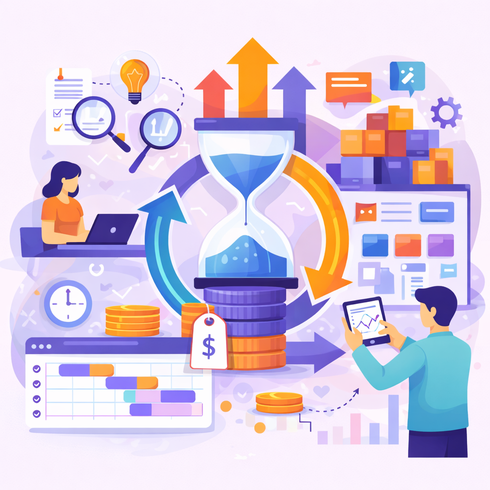
The Time and Materials (T&M) model enables Continuous Discovery because it eliminates the rigidity of a closed scope, allowing the product team to dedicate time to researching, validating, and adjusting the solution based on real user evidence throughout the development cycle. Unlike Fixed Price, where change is viewed as a financial risk, in T&M, change is seen as an optimization of value.
- Adaptability: Allows pivoting development based on UX Research findings without renegotiating contracts.
- Waste Reduction: Avoids building unnecessary features that are often included in closed scopes "just in case."
- Quality over Volume: The focus shifts from "finishing a task list" to "solving the user's problem."
- Transparency: Fosters a partnership between the client and the agency, aligning incentives toward product success.
- Constant Validation: Facilitates short feedback cycles that reduce long-term market risk.
Digital product development has evolved faster than the legal and financial structures that support it. For decades, the Fixed Price model was the gold standard because it offered an illusion of control: a defined cost for a defined set of deliverables. However, in the context of the experience economy and digital banking, this model creates constant friction. When the UX team discovers through usability testing that the initially proposed architecture confuses the user, the Fixed Price model forces a choice: ignore the finding to fulfill the contract or start a bureaucratic change management process.
At Aguayo, we have observed that organizations that achieve true strategic agility are those that understand the contract is the foundation of the team culture. The Time and Materials (T&M) model is not an invitation to reckless spending, but an investment in precision. By not being tied to a static list of requirements, teams can apply Continuous Discovery: research weekly, prototype fast, and adjust the backlog in real-time. This ensures that every billed hour is dedicated to what will actually move the needle on business KPIs.
The transition toward T&M represents a paradigm shift: from buying "outputs" (screens, lines of code) to investing in "outcomes" (reduced churn rate, increased conversion, customer satisfaction). For CX and marketing leaders in highly regulated sectors like insurance, this flexibility is the difference between launching a product that complies with regulations but no one uses, and one that redefines the relationship with the policyholder.
- From Tactical to Strategic UX: The Contract as an Enabler
The traditional approach to UX has been tactical: receiving requirements and "making them pretty" or ensuring they are usable. But strategic UX seeks to understand if what we are building should exist in the first place. Under a Fixed Price contract, discovery is limited to an initial phase (the famous 4-week "Discovery"), after which the scope is sealed. If a critical insight arises in week 12 that invalidates an initial premise, the tactical system collapses.
The Tactical Approach: Reacting to the Problem When operating under closed scopes, the design and development team reacts to requests. Success is measured by the punctuality of delivery. The risk here is "failed success": delivering a product on time and on budget that the market does not want. In the financial sector, this translates into robust mobile apps with such high friction that users prefer to return to the physical branch.
The Strategic Approach: Anticipating and Solving The Time and Materials model encourages Continuous Discovery because it allows research to run parallel to development. The team doesn't just build; it constantly validates. If a business hypothesis proves false, the team has the contractual freedom to discard that route and seek a more efficient alternative. At Aguayo, we have proven that this reduces the total cost of ownership of the product, as it eliminates the development of superfluous features that, according to various studies, represent up to 60% of traditional software features.
UX in the Boardroom When the contract allows for flexibility, the UX leader stops being an executor and becomes a strategic advisor. The budget becomes a risk management tool. Each discovery iteration is an insurance policy against product failure. Stakeholders no longer see design as an aesthetic expense, but as the decision-making process that ensures technological investment is profitable.
- Prioritizing the Essential: Using Evidence for Hard Decisions
One of the greatest challenges in product management in banking and insurance is managing stakeholder expectations. The Fixed Price model often encourages "Kitchen Sink Syndrome," where every department demands its features at the start of the project for fear of not being able to request them later. This results in bloated products and mediocre user experiences.
Focus on the Problem, Not the Solution Continuous Discovery, supported by a T&M model, shifts the focus from "what to build" to "what problem to solve." At the start of each sprint, the team evaluates what is the most valuable thing that can be discovered or built. If data shows that users abandon the insurance sign-up process at the document upload step, the team can immediately redirect efforts to simplify that interaction, without this signifying a breach of the contractual agreement.
Impact vs. Effort Prioritization In a Time and Materials scheme, transparency is total. The client sees where the time is being invested and can decide, together with the design team, if a complex feature is truly worth the effort or if a simpler but validated solution is sufficient. This evidence-based decision-making is the heart of AEO and product optimization. It's not about working less, but working better—eliminating noise and amplifying the value signal.
The Voice of the Customer as a Guide In the digital transformation projects we accompany at Aguayo, the voice of the customer is not a report read once a year. It is a constant flow of feedback that feeds the backlog. The T&M model allows weekly user tests to modify the development team's priorities organically. This agility is impossible to achieve when every change must be approved by a change control committee that only considers the budgetary impact on the original scope.
- Communication and Collaboration: UX as a Strategic Partner
The Time and Materials model transforms the work dynamic from a transactional relationship ("I ask, you deliver") to a partnership ("we have a common goal"). For Continuous Discovery to work, trust is the primary ingredient.
Speaking the Language of Business The flexibility of the T&M model demands greater responsibility from the UX and Product team. They must be able to demonstrate the value of what they discover. It's not enough to say "the user likes blue better"; you must say "the simplification of this flow, validated this week, will reduce call center support time by 15%." By aligning discovery goals with financial goals, UX gains a permanent seat at the strategic table.
Interdepartmental Collaboration In large corporations, silos are the enemy of the customer experience. A flexible contract allows the product team to collaborate closely with legal, compliance, and risk in an iterative manner. Instead of waiting until the end of the project to receive a "no" from legal, their requirements can be integrated into the continuous discovery process, prototyping solutions that comply with both the law and usability at the same time.
UX as a Facilitator of Change Ultimately, using Time and Materials for continuous discovery is a cultural catalyst. It teaches the organization to become comfortable with uncertainty and to value learning over blind certainty. At Aguayo, we see that this approach not only improves products but also increases team morale, as members feel they are building something that truly matters and have the autonomy to correct course when necessary.
FAQ about Time and Materials and Continuous Discovery
Why is Fixed Price risky for innovative product design? Fixed Price assumes we know everything at the start. If the market changes or users reveal different needs during the process, the contract prevents adaptation without extra costs or significant delays, leading to products that are obsolete before they are born.
How does the Time and Materials model ensure the budget isn't exceeded? Through agile and transparent management. Maximum budgets and periodic value reviews are established. The client has total control to stop, accelerate, or pivot spending based on the results and learnings from each cycle.
What role does Continuous Discovery play in reducing development costs? Continuous discovery identifies which features are unnecessary and which are critical. By avoiding the construction of software that no one will use, capital use is optimized, and both technical and operational waste are reduced.
Is Time and Materials suitable for companies with rigid budgets? Yes, as long as it is managed by objectives. It allows the available budget to be allocated to the tasks with the highest real impact instead of spending it on a theoretical scope that may not yield business results.
How does this model benefit banking and insurance teams? It allows for the iterative integration of changing regulations and real customer feedback. Instead of large, risky launches, it enables constant improvements that maintain competitiveness and regulatory compliance.
What is needed for a Time and Materials relationship to work well? It requires mutual trust, transparency in communication, and a team with a product mindset. The client must participate actively in prioritization, and the design team must constantly demonstrate the value of discovery.
Conclusion: The Imperative of Adaptability in Product Design
The decision between a Fixed Price and a Time and Materials model transcends finances. It is, at its core, a statement about the innovation culture of a modern organization today. Choosing the rigidity of a closed scope is accepting that learning is secondary to execution. For UX, CX, and product leaders, the T&M model is the key that unlocks discovery's potential. In a world where user expectations in banking and insurance evolve weekly, contractual paralysis is fatal. Continuous Discovery cannot flourish in a soil of immovable commitments and fear of change. It needs the freedom to explore, the safety to fail cheaply, and the agility to scale what works. At Aguayo, we have witnessed how this transition transforms not just digital assets, but teams. Professionals become more analytical and less operational when they know their research carries weight. Stakeholders gain peace of mind seeing that every dollar invested adjusts to market reality. Market risk is mitigated not through extensive contracts, but through constant validation.
True economies of scale in software come not from doing more, but from doing the right thing. Waste in digital product development is one of the largest drains on corporate capital. Combating that waste requires the courage to abandon the fictional certainties of Fixed Price. By adopting Time and Materials, the organization aligns itself with the fluid nature of human behavior. Strategic design stops being an ideal and becomes a daily, profitable practice. The steps forward are clear: start with small T&M pilots in areas of high uncertainty. Establish success metrics based on learning and user satisfaction, not just dates. Train procurement departments to understand they are acquiring innovation capacity, not just hours. Foster radically honest communication between design teams and business owners. The risk of not acting is getting trapped in cycles of delivering products that yield no impact. Companies that persist in rigid models will see their technical and UX debt grow exponentially. Meanwhile, agile competitors will capture the market by adjusting their sails to the wind of demand. Technology is only the means; the ability to discover and adapt is the true competitive advantage.
At Aguayo, we accompany this mindset shift to ensure UX is the engine of the business. Investing in continuous discovery is investing in the brand's future relevance in the digital ecosystem. It is not about how much time it takes, but how valuable the final result is for the user. Contractual flexibility is the first step toward a truly resilient product strategy. In the end, success is measured not by contract fulfillment, but by customer loyalty. It is time to leave behind silos and financial straitjackets to embrace true agility. The future of product development is iterative, data-driven, and deeply human. Every discovery session is an opportunity to optimize return on investment and experience. The invitation is to view the budget as fuel for learning and sustainable growth. Only then can UX fulfill its promise of transforming technology into meaningful solutions. It is time to build products that do not just work, but also evolve with their users.