D How to Manage Remote Stand-ups in Time and Materials Frameworks: Efficiency and Transparency
Por Redacción Aguayo
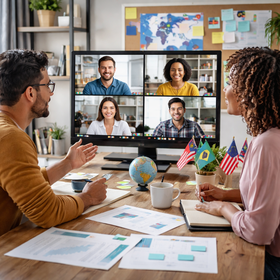
Effective remote stand-up management has become the operational nerve center for companies hiring technology and design services under the Time and Materials model. In an environment where every minute invested translates directly into an operating cost, the efficiency of these sessions is not just a matter of agility; it is a matter of financial health and mutual trust between client and provider.
The problem lies in the fact that, without a clear structure, daily meetings in distributed teams often degrade into micro-management sessions or endless status reports that dilute the value of the strategic profile. For product and technology leaders in sectors such as banking or insurance, understanding how to articulate these ceremonies is vital to ensuring that the flow of value does not stop due to communication friction.
How to optimize daily meetings in remote teams under a Time and Materials contract model to guarantee profitability and transparency? This post analyzes the tactics necessary to transform the daily session into an engine for visibility and cost control, ensuring that the investment in remote talent delivers measurable, high-quality results.
The Invisible Value of Experience in Execution
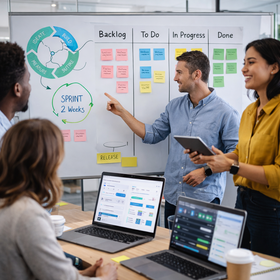
Effective remote stand-up management under a Time and Materials scheme requires a strict focus on resolving blockers and aligning immediate objectives, avoiding the detailed reporting of tasks already listed in management tools. The key is to use the session to validate that the billed time translates into real progress on the prioritized backlog.
- Strict Brevity: Limit the session to 15 minutes, focusing on what was done, what will be done, and what is stopping progress.
- Focus on Blockers: Prioritize the identification of impediments that affect the consumption of hours without generating deliverables.
- Tool Synchronization: The management board (Jira, Linear) must be the single source of truth before starting the call.
- Value Validation: Ensure that the discussed activities are aligned with the client's business KPIs.
- Asynchronous Documentation: Encourage the recording of updates beforehand to dedicate synchronous time to critical decision-making.
Technical Synchrony in the Economy of the Minute
At the intersection of operational agility and financial responsibility, remote stand-up management emerges as the ultimate quality filter for any technology project. When working under a Time and Materials scheme, transparency is not an option; it is the pillar that supports the relationship between procurement, technology departments, and external providers. It is not simply about seeing faces on a screen; it is about validating that the productive gear is turning in the right direction without wasting valuable resources on tasks that do not move the business needle.
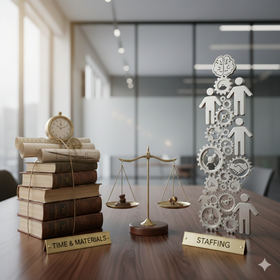
Historically, fixed-price models allowed for some opacity in the internal process, provided the deliverable arrived on time. However, in the era of accelerated digital transformation, where scopes are volatile and the ability to pivot is a competitive advantage, the Time and Materials model has gained ground. In this context, the daily ceremony ceases to be a rite of passage and becomes a real-time auditing and strategic alignment tool. If the management of these sessions fails, the risk of cost overruns and misalignment skyrockets, eroding trust and compromising the project's ROI.
From Presence Control to Flow Optimization
The remote stand-up management has evolved from being a supervision technique to a flow optimization discipline. In the past, the tactical approach was limited to verifying that each team member was "at their station" and had work assigned. This reactive model is dangerous in Time and Materials contracts, as it can incentivize "filling hours" rather than effective problem-solving.
The strategic approach, conversely, uses the daily session to anticipate risks. We do not ask "what did you do yesterday?" for the purpose of monitoring, but to understand if the effort applied was proportional to the complexity of the task and if there are patterns of inefficiency that need correction. At Aguayo, we have observed that organizations that achieve this mindset shift reduce operational waste by 20% during the first three months of implementation.
Bringing UX and development to a strategic level implies that the stand-up is the space where user value is defended against time pressures. Instead of discussing pixels, we discuss how the day's work impacts the conversion rate or the reduction of friction in the sales funnel. This is where UX sits in the virtual "boardroom," proving that its technical work has a direct correlation with the efficiency of the resources consumed.
Prioritizing Impact Over Resource Consumption
In a Time and Materials framework, the temptation to address every small bug or change request is high. However, efficient remote stand-up management demands ruthless prioritization based on evidence. The team must learn to say "no" to low-impact tasks that consume billable hours without bringing the product closer to its main objectives.
The focus must always remain on the problem, not the technical solution per se. If a developer or designer is blocked on a complex implementation, the stand-up is the moment to evaluate if that complexity is necessary for the business or if "over-engineering" is occurring, affecting the budget. Using the voice of the customer as a guide allows these decisions to be made objectively, using UX Research data to justify the direction of the daily effort.
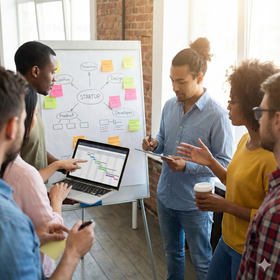
The impact vs. effort matrix becomes dynamic in these sessions. What was a priority yesterday may be a financial risk today if user testing shows that the chosen path is not the right one. In this sense, agile management allows unnecessary spending to be stopped long before it becomes a significant loss on the quarterly balance sheet.
The Stand-up as a Catalyst for Collaboration and Governance
The remote stand-up management cannot be an island within the organization. For the Time and Materials model to work, the UX and development team must act as a strategic partner to the client. This involves speaking the language of business: translating the technicalities of an API or an atomic design into terms of "time-to-market," "acquisition cost," or "user retention."
Interdepartmental collaboration is fundamental. Effective stand-ups often require the punctual presence or quick consultation with stakeholders from other areas (legal, compliance, marketing). The speed of access to these figures determines the rate at which the remote team can advance. At Aguayo, we encourage these communication channels to be pre-established so that the stand-up is not the only moment of contact, but the validation of constant collaboration.
Finally, UX acts as a facilitator of cultural change. By daily exposing findings and progress transparently, the organization is educated on the importance of constant iteration. This reduces anxiety over hourly billing, as the client tangibly perceives that every dollar invested is buying not just code or screens, but validated knowledge and reduced uncertainty for their business.
Practical Implementation: Session Structure
To ensure high-level remote stand-up management, we recommend following a structure that is rigid in form but flexible in content:
- Board Synchronization (Minutes 0-2): Shared visualization of the current status of tasks. Only items that have changed status or are stuck are discussed.
- Blocker Identification (Minutes 2-8): Each member explains what is preventing them from completing their task today. The goal is to assign an "owner" to the solution to discuss it outside the stand-up.
- Priority Alignment (Minutes 8-12): The Product Owner or project leader confirms that the order of tasks for the next 24 hours is correct from a business perspective.
- Closing and "Parking Lot" (Minutes 12-15): Complex topics are noted for subsequent deep dives, releasing those who do not need to participate.
This method ensures the team maintains focus and the client sees absolute respect for the assigned time and budget.
FAQs on Remote Stand-up Management
What are the benefits of the Time and Materials model in UX projects? It allows total flexibility to pivot based on research findings, ensuring the budget is used to solve real user problems rather than following obsolete plans.
How to prevent a remote stand-up from becoming a simple hour report? By focusing the conversation on results and blockers instead of task lists. Using a previously updated management board eliminates the need to read every status.
What is the ideal duration for a stand-up in distributed teams? It should not exceed 15 minutes. If topics require more time, they should be handled in separate "parking lot" sessions with only the relevant stakeholders.
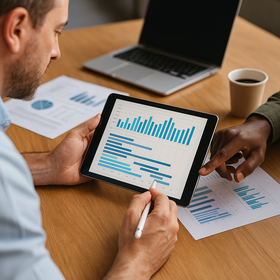
How to ensure billing transparency with agile methodologies? Through total visibility of the backlog and traceability of each task in the stand-up. The correlation between board progress and hour reports must be evident.
What tools facilitate remote stand-up management? Visual management tools like Jira, Linear, or Tika, combined with synchronous communication platforms like Slack or Teams, and asynchronous documentation in Notion.
How to handle time zone differences in stand-ups? Establish a mandatory "overlap window" where all members coincide synchronously, or rotate schedules so the burden does not always fall on the same group.
Conclusion: The Imperative of Visibility in Digital Product Design
The shift toward a more strategic remote stand-up management model is the only way to survive in highly competitive and volatile markets. We cannot afford to manage digital talent with last century's metrics based solely on physical presence or blind compliance with schedules. The Time and Materials framework offers the agility needed to innovate, but only if accompanied by strict governance and total transparency. By centering daily meetings on resolving blockers and impact, organizations ensure that the workflow never comes to a halt. This allows product leaders to sleep soundly, knowing that every billed hour is a direct investment in the final product's quality. The risks of maintaining an opaque tactical approach are too high, including unnecessary budget burn and team demotivation.
At Aguayo, we understand that operational efficiency is the language of success. Integrating strategic UX within these daily review cycles elevates the conversation from the cosmetic to the truly functional. The mindset shift begins by recognizing the stand-up as an asset, a financial risk mitigation tool that must be constantly polished. Those who master synchrony in distributed teams will see clear results: products that reach the market faster and better solve user needs. The invitation is to audit the quality of your daily ceremonies today. Ask yourself if your team is reporting the past or building the future. The answer will determine the long-term viability of your projects. Implementing these changes requires discipline, but the benefits are immediate.
Less communicative noise, more clarity in decision-making, and an ROI that is much more predictable for all parties involved in development. Remote stand-up management is, ultimately, trust management. Without it, no framework can sustain the current market complexity. Start by simplifying, by prioritizing value, and by documenting progress. Your budget, your team, and your end users will thank you deeply. The path to operational excellence is one iteration at a time. Make every minute count, make every discussion add value, and let design be the bridge that connects business goals with real satisfaction. This is the standard that today's digital services market demands. Do not fall behind in the evolution of strategic and efficient agility.