Aguayo

D Avoiding Scope Creep with Time and Materials Projects: How to Maintain Strategic Focus Without Sacrificing Agility

Por Redacción Aguayo

The Time and Materials (T&M) contracting model has established itself as the preferred standard in the modern tech industry, particularly in high-complexity sectors like banking, insurance, and fintech. Unlike fixed-price contracts, which often create perverse incentives and contractual friction, T&M promises agility, transparency, and real alignment with shifting business goals. However, this flexibility carries an inherent and often underestimated risk: the false sensation that scope is infinite because "the clock keeps running."

For CTOs, UX leaders, and product managers, the challenge is not just delivering functional software, but doing so within reasonable parameters of profitability and time. Scope creep in a T&M environment does not manifest as an immediate contract renegotiation, but as a slow, silent erosion of budget and strategic value. What starts as "small tweaks" or "quick improvements" can divert the team from core objectives, resulting in bloated products that take far too long to reach the market.

The critical question we will address is: How do we maintain the agility and adaptability inherent to T&M without falling into the trap of endless, unfocused development? The answer lies in rigorous governance, relentless evidence-based prioritization, and communication that transforms the client-vendor relationship into a true strategic partnership.

Avoiding Scope Creep with Time and Materials Projects
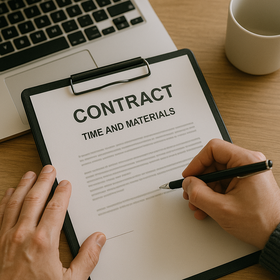
CAPTION: Photo generated from Midjourney

Quick Answer: How to Avoid Scope Creep in Time and Materials?

Scope creep in Time and Materials projects is avoided by shifting the focus from "hours control" to "value management." It is not about preventing changes—the nature of T&M is to allow adaptation—but ensuring that every new requirement displaces a lower-value one, keeping the total effort bounded (a cap and trade approach).

Key points for effective management:

  • Unwavering Product Vision: Establish a clear "Strategic North Star." If a request does not move the product closer to that goal, it is discarded or postponed, regardless of budget availability.
  • Zero-Sum Backlog: Adopt a mindset where the backlog is not a catch-all drawer. If a high-priority feature enters, a low-priority one must exit or move to the bottom of the queue to protect time-to-market.
  • Governance Rituals: Implement weekly or bi-weekly reviews not just of technical progress, but of budget consumption vis-à-vis delivered value.
  • Definition of 'Ready' and 'Done' (DoR/DoD): Be rigorous with acceptance criteria to avoid "gold plating" (unnecessary perfectionism) by design or development teams.
  • Product Owner Empowerment: The PO must have real authority to say "no" to stakeholders, based on user data and technical viability, not hierarchical opinions.
  • Radical Transparency: Visualizing the impact of every change on the project completion projection helps stakeholders understand the opportunity cost of their requests.

Avoiding Scope Creep with Time and Materials

Navigating Volatility with Purpose

The transition from traditional waterfall models to agile methodologies brought about the popularization of Time and Materials contracts. In theory, this model is the panacea for innovation: it allows work to begin without having every requirement defined to the millimeter and facilitates pivoting when the market or users demand it. However, at Aguayo, we have observed that without adequate maturity, this freedom becomes a trap. Teams and stakeholders often confuse the ability to change course with the absence of a destination.

In the context of large financial corporations or insurance firms, where budgets can be substantial, there is a danger of complacency. Scope creep in T&M is insidious because it doesn't hurt immediately. In a fixed-price contract, a scope change triggers a Change Order that requires signatures and approvals, generating friction that, while annoying, acts as a control barrier. In T&M, the change is simply added to the sprint. "It's just a few more hours," they say. But the accumulation of these "few more hours" dilutes the product's purpose, delays the launch, and paradoxically increases technical debt even before the first version is in production. To navigate this volatility with purpose, solid mental and operational structures must be established.

1. From Contractual Control to Product Discipline

The first step to preventing scope overflow is a fundamental shift in mindset. In T&M, the contract does not protect you from scope creep; only your product discipline protects you.

The Fallacy of "We Want It All" In many projects, stakeholders assume that because they are paying for the team's time, they can use that time for any request that arises. This turns high-performance teams into mere "order takers" (feature factories). The product leader must educate the organization: the T&M team is not there to build whatever; they are there to solve a specific business problem as efficiently as possible.

  • The Problem: Treating the development/UX team as an extension of operational capacity without a strategic filter.
  • The Solution: Establish Objectives and Key Results (OKRs) linked to the project. Every user story or requirement must have direct traceability to a Key Result. If someone asks for a "PDF export button," the question is not "how long will it take?", but "how does this impact the retention or conversion goal?".

The Danger of Perfectionism (Gold Plating) Scope creep does not always come from business stakeholders; sometimes it comes from within. UX designers seeking the perfect micro-interaction or developers wanting to refactor code prematurely can inflate the scope. In a T&M model, where there is no immediate penalty for taking longer, the technical team must have ironclad self-discipline.

  • Strategy: Strictly define the MVP (Minimum Viable Product) or MVA (Minimum Awesome Product). Anything exceeding the essential functionality to validate the hypothesis or satisfy the core user need is, by definition, scope creep in that phase.

2. Relentless Prioritization: The Economics of Scope

To manage scope in T&M, we must apply basic economic principles: resources (time and budget) are limited, while desires are unlimited. The only way to solve this equation is through aggressive prioritization based on evidence.

The "Cap and Trade" Model This is one of the most effective techniques we recommend. A fixed time/effort budget is established for a phase or release (the "Cap"). If a stakeholder wants to introduce a new feature, they are welcome to do so, but they must "Trade" it for an existing feature of equivalent size that will be removed from the current scope.

  • Why it works: It forces stakeholders to make value judgments. It is no longer "do we want this?", but "do we want this more than that?". It transforms the discussion from an abstract desire to a concrete business decision.

Impact vs. Effort Matrix in Real-Time In digital banking or insurance projects, where technical complexity is high (integrations with core banking, regulations, security), it is vital to visualize the real cost of requests.

  • Visualization: Keep a visible matrix where every functionality is mapped.
  • The Quadrant of Death: Quickly identify "Low Impact / High Effort" requests. These are the main culprits of scope creep. In T&M, it is easy to fall into the temptation of tackling them because "we have time," but they consume a disproportionate amount of budget.

Decisions Based on the Voice of the Customer When in doubt about whether to include a feature (and thus expand the scope), the answer is rarely in the boardroom. It is in the data.

  • UX Research as a Filter: Before committing development hours to a new "bright idea" from a director, it must be validated with rapid prototypes. If the user does not value or understand it, it is discarded. This saves weeks of T&M development that would have been wasted. At Aguayo, we have seen how one week of research can save months of useless development.

3. Communication, Governance, and Transparency

Scope creep flourishes in the dark. When it is unclear how much budget has been consumed versus how much product has been built, the scope grows uncontrollably.

Visual Management of Burn-rate In T&M, the client must know exactly how fast their money is being consumed. A monthly report of billed hours is not enough.

  • The Ideal Report: It must show "Percentage of Budget Consumed" vs. "Percentage of Scope Completed." If you have spent 50% of the budget but have only completed 20% of the initial estimated scope, you have a red alert for scope creep or technical underestimation.
  • Early Action: This visibility allows for difficult decisions to be made in Week 4, not in Week 24 when the money runs out.

Alignment Rituals (SteerCo) For large projects, it is fundamental to establish a Steering Committee (SteerCo) that meets monthly.

  • SteerCo Agenda: This is not for watching demos. It is for reviewing the roadmap and the budget. Here, requested changes are presented, their impact on the launch date is evaluated, and significant scope variations are formally approved or rejected. This formalizes change even within the flexibility of T&M.

The Role of UX/UI as Scope Guardian Design is often seen as a preliminary phase, but in T&M, design is continuous. The design team has the responsibility not to design "castles in the air" that are unfeasible to build within the budget.

  • Modular Design and Design Systems: Using a robust Design System prevents designers from reinventing the wheel on every screen, which in turn reduces uncertainty and scope creep in the front-end development phase. Consistency reduces complexity.

Managing Technical Debt An invisible factor of scope creep is unmanaged technical debt. If the team rushes to add more features without refactoring, the team's velocity will drop drastically.

  • The 20% Rule: Reserve a percentage of the T&M team's capacity (e.g., 15-20%) exclusively for maintenance, refactoring, and technical debt. If not made explicit, this work will be done "under the table" anyway, inflating delivery times for visible features and appearing as unjustified scope expansion.

4. Collaboration as the Antidote to Distrust

Finally, scope creep often stems from distrust. The client asks for everything possible "just in case" there is no second phase. The vendor accepts everything so as not to "upset" the client.

Building Trust Through Early Deliveries The best way to calm the anxiety that causes scope creep is by delivering working software fast. When stakeholders see tangible value in production, their need to cram the backlog diminishes. They understand that the product is a living organism that will evolve.

  • Product vs. Project Mindset: In a "project," the scope is fixed and the end is definitive. In a "product," development is continuous. Helping the organization transition towards a product mindset reduces the pressure to put "everything" into Version 1 (V1).

The Language of Business UX and Tech leaders must learn to justify rejecting new features in financial terms. Do not say: "We can't do this because the code is complex." Say: "If we include this now, we will delay the launch by two weeks, which will cost us X in opportunity cost and Y in additional development budget. Is the investment worth it?".

FAQ: Questions about Scope Creep in T&M

Is a Fixed Price contract better for avoiding scope creep? Not necessarily. Fixed Price hides scope creep under rigid "change management" which usually generates conflict, renegotiation costs, and products that are obsolete upon delivery. T&M offers better control if there is good governance.

How do I say "no" to a director asking for changes in a T&M project? Don't say "no," say "yes, but...". Explain the consequences: "We can add that feature, but to maintain the budget and date, we must remove this other low-priority feature. Do you agree?"

What tools help visualize scope creep? Tools like Jira or Azure DevOps, using Burn-down and Burn-up charts. It is vital to correctly label new user stories added post-kickoff to differentiate original scope from new scope.

Can the UX team cause scope creep? Yes. If UX designs complex solutions without validating technical feasibility with developers, or if they seek to perfect visual details with no business value (gold plating), they are inflating the scope unnecessarily.

How do I manage the budget if the scope isn't 100% defined? Work with budgets by phases or milestones (e.g., MVP budget). Conduct "stop/go" reviews at the end of each phase to decide whether to invest more capital based on the results obtained.

What is "Gold Plating" and how does it affect the project? It is adding features or refinements that the client did not ask for and that do not add critical value, simply due to team perfectionism. In T&M, this consumes budget directly and must be avoided by the Product Owner.

Conclusion: Orchestrating Agility with Precision

Managing Evolution Without Losing Direction

Adopting a Time and Materials model does not mean signing a blank check or relinquishing managerial control; on the contrary, it demands a superior level of maturity in product management. True success in these projects does not lie in the rigidity of contractual clauses, but in the leaders' ability to navigate uncertainty with a clear strategic compass. Scope creep ceases to be a threat when it is transformed into a conscious value exchange decision, where every new backlog addition undergoes a rigorous impact versus effort filter. For banking and insurance organizations, where digital transformation is imperative, the key lies in empowering Product Owners and UX leaders to act as true guardians of budget and vision. This implies fostering a culture where saying "no" or "not now" is viewed as an act of financial and strategic responsibility, rather than a lack of technical capability. Transparency in resource usage and constant visualization of progress are the tools that disarm distrust and align all departments toward a common goal. The risk of not acting under these principles is high: products that never see the light of day, budgets that double without clear returns, and teams burned out by forced marches toward moving targets.

Conversely, by implementing dynamic governance, we turn the flexibility of T&M into our greatest competitive advantage, allowing us to react to the market without losing operational efficiency. Ultimately, avoiding scope creep is not about preventing the product from growing, but ensuring it grows in the right direction.

It is about maintaining the right velocity. It requires delivering real value to the user. It demands a focus on the business from the very first sprint. It necessitates a partnership built on transparency. It relies on data, not opinions. It asks for discipline in every daily stand-up. It means prioritizing what truly matters. It involves constant communication with stakeholders. It turns potential chaos into structured innovation. It protects the team's focus. It safeguards the client's investment. It ensures that agility serves the strategy. It prevents the roadmap from becoming a wish list. It makes the Definition of Done a law. It keeps the burn rate sustainable. It respects the time-to-market. It validates assumptions before building. It celebrates outcomes, not just output. It builds trust through delivery. It aligns technology with business goals. It creates a rhythm of continuous improvement. It minimizes waste and maximizes impact. It ensures the final product is what the market needs.

By mastering this balance, Aguayo ensures that T&M projects deliver exceptional results on time and on budget.


Contact Us

More blog

About work, workshops, creative processes, new clients, old clients, daily life, and UX, epistemological thoughts, and critiques.

The Hidden Strategic Advantages of Time and Materials over Traditional Outsourcing

The Hidden Strategic Advantages of Time and Materials over Traditional Outsourcing

In the high-stakes world of digital product development, choosing an outsourcing engagement model is one of the most critical decisions a leader can make. For decades, the traditional "Fixed Price" (or "Fixed Bid") contract has been the gold standard for corporate procurement. It offers a seductive promise: a clearly defined scope, a firm deadline, and, most importantly, a predictable cost. On paper, it's the responsible, low-risk choice.

But in practice, this perceived safety is an illusion.

The fixed-price model is a relic from an industrial era, designed for building predictable commodities like bridges and buildings. It is fundamentally unsuited for the volatile, exploratory, and human-centric nature of software development. In an environment where user needs evolve and the best solution is discovered, not defined, the fixed-price contract becomes a liability. It actively punishes innovation, creates adversarial relationships, and strangles the iterative process that is the lifeblood of great UX/UI design.

This article explores the hidden strategic advantages of the "Time and Materials" (T&M) model. We will dismantle the myth of fixed-price security and demonstrate why paying for expertise, time, and process—rather than a static list of features—is the most intelligent, agile, and value-driven approach to building products that win.

Read entry
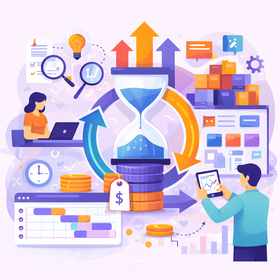
Ilustración del modelo de proyecto Time and Materials.

Time and Materials Explained: A Flexible Model for Complex Projects

In today's dynamic industry, projects rarely follow a predefined path from start to finish. Requirements change, technologies evolve, and goals are adjusted. In this context, fixed-price contracts often prove inflexible, leading to cost overruns, frustration, and unsatisfactory final products. This is where the Time and Materials (T&M) model emerges as a powerful alternative. Unlike a fixed-price contract, T&M focuses on flexibility and collaboration, adapting to the unpredictable nature of complex projects. This blog post breaks down this model, explaining why it is the ideal choice for innovation and how to manage it effectively to ensure the project remains aligned with business objectives.

Read entry
Building Trust with Clients

Building Trust with Clients: The Strategic Advantage of Time & Materials

In the world of project management, trust is the ultimate currency. While fixed-price contracts promise a predictable outcome, they often create an adversarial dynamic between clients and providers, leading to a focus on scope and price rather than shared goals. The Time & Materials (T&M) model offers a powerful alternative. By its very nature, it fosters a relationship built on transparency, flexibility, and collaboration. This blog post explores how T&M moves beyond a transactional agreement to become a strategic partnership, and provides practical, actionable strategies for building and maintaining deep trust with your clients throughout a project’s lifecycle.

Read entry
Choosing the Right Time and Materials Partner in LATAM: A Strategic UX/UI Perspective

Choosing the right "Time and Materials" partner in LATAM: A Strategic UX/UI Perspective

The Latin American (LATAM) region has emerged as a premier destination for Time and Materials (T&M) and nearshoring engagements in the software development world. Its competitive advantages—including a favorable time zone overlap with North America, a growing talent pool, and cultural affinity—make it an attractive proposition. However, the T&M model, which relies on a fluid scope and close collaboration, demands a partner selection process that goes far beyond a simple rate comparison. For a project to succeed, particularly in the complex and iterative domain of UX/UI design and subsequent development, the chosen partner must be an extension of your strategic team, not just a contractor. This blog post dives deep into the strategic, often overlooked, criteria that ensure you select a LATAM T&M partner capable of delivering true user value, fostering innovation, and managing the inherent risks of a flexible engagement model.

Read entry
The synergy between Agile and the T&M model.

Why Agile Teams Prefer Time and Materials for Scaling Operations

In today's fast-paced business environment, scaling is not just about growing a team; it's about expanding a company's ability to innovate and deliver value. Traditional project management models, with their rigid scopes and predefined timelines, often create bottlenecks that stifle the very flexibility Agile teams are built on. This is where the Time and Materials (T&M) contract model emerges as a powerful enabler. It provides the financial and operational agility necessary to support the iterative, customer-centric nature of Agile. This article will explore the deep synergy between T&M and Agile, explaining why this combination is a strategic choice for teams looking to scale their operations efficiently and effectively.

Read entry
Time and Materials in Practice: Lessons from Real LATAM Collaborations"

Time and Materials in Practice: Lessons from Real LATAM Collaborations

In the dynamic landscape of technology and design, particularly in the vibrant and often unpredictable region of Latin America (LATAM), contracting and project management models are crucial for success. The Fixed Price scheme offers budgetary certainty but often strangles the flexibility that is a pillar of User-Centered Design (UCD). On the other hand, the Time and Materials (T&M) model, which budgets for work time and resources used, has solidified itself as a powerful tool for UX/UI projects where research and iteration are fundamental.

This model, by offering superior flexibility, allows design teams to react to user research discoveries, pivot based on usability tests, and ultimately deliver a more relevant and valuable product. However, its success in LATAM is not without challenges: it demands rigorous discipline, transparent communication, and, above all, a strategic alignment that transcends mere hourly billing. This blog post explores the most valuable practical lessons learned from real collaborations in the region, focusing on how UX/UI design can flourish and demonstrate its intrinsic value within the fluid T&M structure. The key is not just billing for hours, but ensuring that every billed hour generates measurable value for both the business and the user.

Read entry
Managing_Risk_Effectively_in_Time_and_Materials

Time and Materials Contracts: Managing Risk Effectively

In the landscape of digital product development, the contract model chosen between a client and a partner is rarely just a financial formality; it is a structural determinant of the project's success or failure. For leaders in banking, insurance, and technology, the tension is palpable: Procurement departments traditionally favor the perceived certainty of Fixed Price contracts, while product and technology teams require the flexibility of Time and Materials (T&M) to execute true Agile methodologies. The conflict arises from a fundamental misunderstanding of where risk actually lies in software development.

While Fixed Price models promise cost certainty, they often result in rigid scope adherence that stifles innovation and incentivizes vendors to cut corners to protect margins. Conversely, Time and Materials models align incentives toward quality and adaptability but introduce the fear of the "blank check"—an open-ended commitment with no guaranteed ceiling. This fear often drives organizations back to rigid contracts that are ill-suited for the complexity of modern user experience (UX) and technical challenges.

The central question for leadership is not which model eliminates risk—because no model can—but rather how to manage that risk intelligently. How can an organization embrace the flexibility of T&M to build superior products while maintaining the fiscal discipline and accountability required by the boardroom? This article explores the strategic governance, mindset shifts, and operational frameworks necessary to turn T&M contracts from a financial liability into a competitive advantage.

Read entry
A project manager and a client collaboratively reviewing a project budget and timeline on a digital tablet.

Mastering the Flow: How to Budget Effectively Using a Time and Materials Approach

In the dynamic world of project management, particularly in software development and creative industries, the only constant is change. Traditional fixed-price models, while offering apparent cost certainty, often crumble under the weight of evolving requirements, unforeseen complexities, and the very innovation they are meant to foster. This rigidity can lead to contentious change orders, compromised quality, or stalled projects. Enter the Time and Materials (T&M) model—a framework designed for agility and transparency. However, its inherent flexibility is often misinterpreted as a lack of financial control, a "blank check" that terrifies budget holders. This perception couldn't be further from the truth. Effective T&M budgeting is not about relinquishing control; it's about exercising it differently. This comprehensive guide will dismantle the myths and provide a strategic, actionable framework for mastering the T&M approach, transforming it from a source of financial anxiety into a powerful tool for delivering exceptional value.

Read entry
Strategic comparison between Time and Materials and Fixed Price for growing Startups.

Time and Materials for Startups: Scaling Without Overcommitting

Main Keywords:

  • Time and Materials (T&M)
  • Time and Materials contract
  • Agile development for startups
  • Scaling digital products
  • Flexible budget management
  • IT outsourcing models
  • Strategic staff augmentation
  • Product Market Fit

Related Questions:

  • What is the difference between Fixed Price and Time and Materials?
  • How to control the budget in a Time and Materials contract?
  • When should a startup use Time and Materials for software development?
  • How does the engagement model affect UX quality in startups?
  • What are the risks of Time and Materials for small companies?
Read entry
AB Testing

Best Practices for Conducting A/B Tests in UX Design

This methodology not only allows us to make data-driven decisions but also eliminates guesswork, clearly showing us what works best for our users. However, running effective A/B tests isn’t just about launching two versions of something and seeing which one wins. It’s a meticulous, nuanced process that can make the difference between a marginal improvement and a quantum leap in conversion rates. 🚀

Read entry
alfred.aguayo_psychology_--v_6.1_7aab8a7f-5367-4996-bd37-a3ae23399f3d

The Psychology Behind User Behavior

Understanding how people think, make decisions, and react to different stimuli is key to designing products that are not only efficient but also intuitive and enjoyable to use. Throughout this article, we will explore the psychological principles that influence digital interaction, how cognitive biases affect user decisions, and how we can apply this knowledge to improve usability and conversion in digital products. 🎯

Read entry
mapas de calor

User Behavior Analysis: How to Interpret Heatmaps and Clicks

When it comes to improving user experience (UX), nothing is more revealing than observing how people interact with a website. Where do they click? Which sections do they spend the most time on? Which ones do they completely ignore? Heatmaps and click analysis are key tools to answer these questions, providing a detailed view of user behavior. But interpreting them correctly goes beyond just looking at colors and bright spots on a screen—it requires context, intent, and a well-thought-out optimization strategy.

Read entry
ux professional

How to Build a UX Carreer: Abilities and Key Tools

User experience (UX) design is one of the most exciting and constantly evolving disciplines in the digital world. Whether you're starting from scratch or looking to strengthen your profile, building a career in UX requires a combination of technical skills, creativity, and a deep understanding of human needs. But don’t worry, this guide will walk you through the essentials step by step so you can become a solid and well-prepared professional.

Read entry
alfred.aguayo_UX_Portfolio_--v_6.1_6be34876-e5a9-4661-93ce-5432e430a006

UX Portfolios: Tips for Creating an Impressive One

Creating an impressive UX portfolio is not just about aesthetics—it is your personal brand, your sales pitch, and your best opportunity to showcase how you think as a designer. A great portfolio doesn’t just display projects; it tells stories, reveals processes, and clearly demonstrates your impact on every product you’ve worked on.

Are you ready to build yours? Here’s everything you need to make it truly stand out.

Read entry
Principios De Diseño Persuasivo Aplicados Al UX

Persuasive Design Principles Applied to UX

Design is not just about creating beautiful interfaces; its true power lies in its ability to influence user behavior. Every color, every white space, every word has the potential to persuade. When we apply persuasive design principles in UX, we harness both cognitive and emotional psychology to guide users into making decisions that benefit them as well as our business objectives. It’s not about manipulation, but rather about facilitating intuitive, satisfying, and meaningful experiences.

Read entry
Cómo Usar La Teoría del Color Para Influir en las Decisiones del Usuario

How to Use Color Theory to Influence User Decisions

Imagine opening an e-commerce application and immediately being drawn to a "Buy Now" button that stands out from the rest. Without thinking too much, you click on it. It’s not a coincidence—it’s design. The color of that button was carefully selected to grab your attention and guide your behavior.

Color theory is not just about aesthetics; it’s a visual communication strategy that can enhance usability and conversion in a digital product. From the way colors evoke emotions to how they guide user navigation, understanding their impact will allow you to make more effective and results-oriented design decisions.

If you've ever wondered why certain colors work better than others in digital interfaces, this article will help you uncover the answer. You’ll learn how to use color to improve user experience, optimize accessibility, and strengthen your brand’s visual identity.

Read entry
cursos ux

Recommended UX Certifications and Courses

In a highly competitive job market, certifications and specialized courses can make a significant difference between being a self-taught designer and a professional with structured knowledge backed by reputable institutions. Whether you are just starting in UX or have experience and want to refine your skills, investing in continuous learning can open doors to better career opportunities and provide a competitive advantage.

However, an important question arises: Is it really worth getting a UX certification?

Read entry
Stakeholders_entendiendo_UX

How to Sell UX to Stakeholders and Business Teams

Talking about UX with business teams can feel like trying to sell air. How do you explain to someone that they can't see or touch user experience design, but without it, their product could fail? The key is to shift the focus: instead of talking about design, talk about results, efficiency, and return on investment. At the end of the day, stakeholders aren’t looking to "do UX"—they want to improve their business. 🎯

Read entry
Interacción con soporte o chatbots

UX and User Retention: Strategies to Reduce Churn

When we talk about user retention, user experience (UX) is not just another factor—it is the heart of any effective strategy. If a digital product fails to engage, motivate, and satisfy its users, they will simply leave. Churn (the rate of user abandonment) is the natural enemy of profitability and growth, and more often than not, a poor UX is what triggers it. So, how can we design experiences that keep users engaged in the long run? Let’s explore.

Read entry
UX en e-commerce: Cómo mejorar la experiencia de compra en línea

UX in E-commerce: How to Improve the Online Shopping Experience

E-commerce has transformed the way we shop, but not all online experiences meet user expectations. Confusing navigation, slow load times, or a complicated checkout process can mean the difference between a successful sale and an abandoned cart.

This analysis explores how to optimize UX in online stores, covering aspects such as speed, personalization, trust, and customer support. More than just design, it’s about creating seamless and efficient experiences that turn visitors into repeat buyers.

Read entry
0_3 (1)

UX in Startups: How to Design with Limited Resources

When we think about User Experience (UX) design, it’s easy to picture large teams with generous budgets, conducting extensive user testing, and using advanced tools. However, in a startup, the reality is quite different: resources are limited, time is scarce, and every decision matters. How can you design an exceptional experience without a million-dollar budget? Here, I’ll share strategies, approaches, and the right mindset to achieve it.

Read entry
ux_in_branding

UX and Branding: How to Build a Brand Identity Through User Experience

When we think of branding, the first things that come to mind are usually a logo, typography, or a brand's color palette. However, branding is much more than a visual identity; it is the complete perception that users have of a brand, and that includes the experience they have when interacting with it. This is where UX (User Experience) comes into play as a key ally in building memorable brands.

Read entry
product_roadmap

How to Prioritize UX Improvements in a Product Roadmap

Imagine having an endless list of ideas to improve your product's user experience. Each one seems valuable, each one promises impact, and each one has passionate advocates within the team. How do you decide which ones to implement first? This is one of the most important questions in product and UX management. Prioritization is not just a matter of preference but of strategy, data, and a clear vision of both the business and the user.

Read entry
ux_writing

UX Writing: How to Improve the Experience with the Power of Words

When we talk about user experience, we often think of well-designed interfaces, smooth interactions, and harmonious colors. However, there is a fundamental component that is often overlooked: words. UX Writing is not just about “writing pretty texts” but a strategic discipline that guides, informs, and builds trust in users within a digital interface.

Read entry
mensajes_de_error_efectivos_en_ux

Creating Effective Error Messages: UX Writing to Improve Usability

When things don’t go as the user expects, error messages become a critical point of contact. These are moments filled with frustration, but also opportunity. Instead of being a simple reminder that something went wrong, a well-crafted error message can guide, reassure, and return control to the person interacting with the interface. Writing effective UX copy in these situations can make a significant difference in how a brand or product is perceived. 📎

Read entry
Storytelling en UX

Storytelling in UX: How to Design Engaging Narrative Experiences

Storytelling isn’t just for books, movies, or TV shows—it's also a powerful tool in digital experience design. In UX, storytelling helps us connect with users on a deeper, more emotional level. It gives meaning to the journey, creates motivation, and, above all, makes people feel like they’re part of something. Designing with narrative is giving a soul to an interface. 📖

Read entry
landing_page_form

How to Design Intuitive and User-Friendly Forms

Forms are one of the most critical touchpoints between users and digital products. They’re where the most important actions happen: creating an account, making a purchase, submitting a request, subscribing, or booking a service. But even though they’re at the heart of many digital experiences, forms remain one of the most overlooked and mistreated elements of interface design.

Read entry
ux_in_the_metaverse

UX in the Age of the Metaverse: Challenges and Opportunities

Today, with the arrival of the metaverse as a promise of persistent, interactive, and immersive 3D environments, UX professionals are facing a new and challenging landscape. It's not just a new channel—it’s a new paradigm of interaction, presence, and design. This new stage compels us to rethink many of the foundations we once took for granted.

Read entry
wearables

UX Design for Wearable Devices

When designing experiences for wearables, we step into a space where the interface is no longer just visual—it becomes something you feel, something you wear, and, in many cases, something that merges with your body or surroundings. Devices like smartwatches, augmented reality (AR) glasses, and virtual reality (VR) headsets have radically changed how we interact with technology. It’s no longer about clicking; it’s about moving, looking, touching, even speaking. This kind of design requires us to think beyond the screen: to consider context, physical limitations, and entirely new languages of interaction. 🧠

Read entry
ux_en_interfaces_de_voz

UX Design in Voice Interfaces: How to Improve the Experience with Virtual Assistants

In a time where we’re speaking more and more to our devices, virtual assistants have become an everyday tool: we set alarms, check the weather, ask questions, and even control our homes using our voice. But behind that “magic” lies a critical layer that is often overlooked: user experience (UX) design focused on voice interfaces. Unlike a touchscreen or a web page, voice introduces an entirely different kind of experience—one that demands new approaches to usability, empathy, and conversational structure. Designing for ears and words is a fascinating challenge.

Read entry
UX_en_vida_real

UX Design in Screenless Environments: Conversational and Haptic Experiences

Traditional UX design has lived—and still lives—on screens. From graphical interfaces on computers to mobile apps, user experience has long been anchored in the visual. But we now live in an era where screens are no longer the only medium of interaction. The rise of voice assistants, wearables, haptic devices, and immersive environments presents a new challenge: how can we design experiences that are just as intuitive, enjoyable, and effective when there’s no screen to guide the user? This question opens the door to a fascinating world of possibilities and responsibilities.

Read entry
UX_y_neurociencia

UX and Neuroscience

Understanding how our minds react to screens, buttons, and animations can be the key difference between a product that feels natural and one that feels frustrating, even if it functions well. Neuroscience gives us clues into how we perceive, feel, and make decisions in digital environments, opening a world of possibilities for designing more human, intuitive, and effective experiences. 🧠

Read entry
Cultura_UX_en_las_empresas

UX Culture in Companies: How to Build a User-Centered Mindset

Adopting a UX culture is not just about hiring designers or having fancy tools. It's about transforming the way an organization thinks, collaborates, builds, and makes decisions. A user-centered mindset is a strategic vision that places people at the center—not just in design, but throughout the entire business experience. Building this culture takes time, consistency, and leadership, but the benefits are tangible: more intuitive products, better-aligned teams, and happier users. 🧠

Read entry
digital_products

UX in Freemium Products: How to Balance Monetization and User Experience

Freemium models dominate today’s digital ecosystem—from productivity apps to design tools, video games, and educational platforms. But with their popularity come complex challenges. The hardest of all: how can we design an experience that is appealing and useful in its free version, while also motivating users (without pushing them) to pay? This delicate balance between value and conversion is at the heart of UX in freemium products.

Read entry
errores de ux

Common UX Mistakes and How to Avoid Them

Ensuring that interactions with your website or application are intuitive, functional, and satisfying is paramount. However, even seasoned designers can fall into pitfalls that negatively impact usability and brand perception. Let's delve into some of the most common UX mistakes and how to steer clear of them.

Read entry
user_experience_research

How to Conduct Effective User Research

When it comes to user-centered design, user research is like having a secret weapon. It allows us to step into the shoes of the people we're designing for, uncovering their needs, desires, and frustrations. It's the difference between creating something that's "okay" and something that truly resonates. If you're ready to level up your designs, let’s dive into how to conduct effective user research in a friendly and practical way.

Read entry
Good practice

The Impact of a Good User Experience on Business

In today's competitive business landscape, User Experience (UX) has become a pivotal factor for success. It's not just about offering quality products or services; it's about ensuring that customers enjoy every interaction with your brand. A well-crafted UX not only enhances customer satisfaction but also boosts key business metrics such as conversion rates, retention, and brand recognition.

Read entry
diseno centrado en usuario

Introduction User Centered Design

User-Centered Design (UCD) is a design approach that places the user at the core of the design process. This methodology not only aims to create appealing experiences but also to solve real problems and meet the specific needs of the people interacting with a product or service.

In a world where user expectations evolve rapidly, UCD becomes a cornerstone for the success of any digital or physical project. More than just a set of techniques, it’s a mindset that prioritizes empathy, research, and collaboration.

Read entry
mapa de empatia

Empathy Maps: What Are They and How to Use Them?

Empathy is one of the most powerful skills we can develop as UX designers. It allows us to deeply understand people, their needs, and their emotions. In the design world, one tool that helps us translate this understanding into action is the empathy map. This visual tool not only makes it easier to identify the most human aspects of our users but also fosters collaboration among teams. Let’s dive in! 🙂

Read entry
UX design

The Key Principles of User-Centered Design

User-Centered Design (UCD) is a philosophy and methodological approach that places individuals at the heart of the design process, ensuring that developed solutions meet their needs, expectations, and limitations. This approach is vital for creating products, services, and experiences that are functional, intuitive, and satisfying for end-users. Below are the key principles of UCD and how they can be applied to enhance user experience (UX).

Read entry
UX

What is UX and why is it important?

When we talk about User Experience (UX), we’re diving into much more than just how someone uses a product. UX encompasses the entire range of feelings, perceptions, and emotions a person experiences when interacting with a product or service.

Read entry
melisa-hildt-aV2uMw3zfwQ-unsplash

What are the Nielsen's 10 Usability Principles?

Exploring usability principles is essential for creating effective digital experiences. In this article, we will delve into the 10 Usability Principles proposed by Nielsen Norman Group, a crucial reference in the design world. These principles provide solid foundations for the development of user-friendly interfaces.

Read entry
dan-dimmock-sNwnjxm8eTY-unsplash

4 Key Aspects for Effective UX Research

Dive into the fascinating realm of user experience (UX) research with our 4 key aspects. Discover how to optimize your design processes, understand your audience, and create digital experiences that truly resonate with users.

Read entry
dan-dimmock-sNwnjxm8eTY-unsplash

What is the PURE Method for Usability Evaluation of a Digital Product?

In the fast-paced world of digital design, where user experience stands as an undeniable cornerstone, usability evaluation methodologies become crucial tools. Among these, the PURE Method (Pragmatic Usability Rating by Experts) stands out, a creation of the renowned Jakob Nielsen, a pioneer in usability discipline. This pragmatic approach has revolutionized the way we evaluate the interaction between users and digital products.

Read entry
ux-indonesia-WCID2JWoxwE-unsplash (2)

'The Design of Everyday Things' by Donald Normann: Key Lessons for Sensible Design

In this article, we will explore the fundamental lessons that this influential book offers for achieving sensible design in our everyday life. From the psychology of design to the importance of visibility and feedback, immerse yourself in the keys that will transform your perspective on the world around you.

Read entry
Blog_How-to-make-a-flow-chart-process_

Difference Between a Flowchart and Sitemap: Essential UX Design Guide

In the world of UX design, the visual representation of processes and structures is essential. Two key tools in this industry are Flowcharts and Sitemaps. Although they share the purpose of clarifying complexity, each has a unique focus. In this guide, we will explore the crucial differences between a Flowchart and a Sitemap, offering a detailed insight so you can choose the right tool at each stage of your design project.

Read entry
LikertScale_blog_FULL-min

Likert Scale for UX Surveys: Optimizing Data Collection

In the realm of user experience (UX) research, the Likert scale emerges as a vital tool to capture user perceptions and attitudes. In this article, we will delve into how to implement and leverage this scale in UX surveys, maximizing data quality and providing valuable insights for the continuous improvement of products and services.

Read entry
60409e9f127600b542827395_JTBD1

'Jobs to be Done': How to Discover and Satisfy Customer Needs

Discover how to identify and address customer needs through the "Jobs to be Done" strategy. This innovative approach focuses on understanding what motivates customers to "hire" a specific product or service and how you can effectively meet those needs, ensuring exceptional customer experience and long-lasting competitive advantage.

Read entry
Prototype-ux-user-experience

UX Prototypes

Discover how prototypes are essential in User Experience (UX) design, their importance in the creative process, and best practices for their development and evaluation.

Read entry
Diseñadores

Free Resources for UX Designers

UX design is constantly evolving, and staying updated can be challenging on a budget. Fortunately, free resources like design tools, inspiration libraries, and online courses can help enhance your skills and keep up with industry trends. 🌟

Read entry
diseno personas discapacidad

Guide To Designing Accessible Websites For People With Disabilities

Designing accessible websites isn’t just a technical exercise; it’s an opportunity to create a positive impact. Beyond meeting regulatory standards, designing with accessibility in mind is an act of empathy that reflects a commitment to diversity. In this article, we’ll explore how you can integrate accessibility practices into your web design to create experiences that truly reach everyone.

Read entry
tendencias ux 2025

UX Design Trends for 2025

UX Design in 2025 promises innovation and new ways to interact with technology: inclusive interfaces, immersive experiences, and both functional and emotional solutions. 🚀 Discover the trends that will define this year.

Read entry
asistentes virtuales

UX in Artificial Intelligence: Case Studies in Chatbots and Virtual Assistants

Artificial Intelligence (AI) is transforming the way we interact with technology, and chatbots and virtual assistants are clear examples of how these tools can make our lives easier... or more frustrating. Designing user experiences (UX) in this context involves not only understanding how algorithms work but also how people perceive, use, and trust these technologies. In this article, we will explore case studies and key strategies to enhance the experience in chatbots and virtual assistants. 🌟

Read entry
brooke-cagle-tLG2hcpITZE-unsplash

Identification of Emotions: Forge Deeper Connections with Users through Emotion-Driven UX

It's not enough for websites and applications to merely function; they must also connect with users on a profound emotional level. The field of User Experience (UX) design recognizes the significance of emotions and how they influence user behavior and decisions. This understanding has given rise to emotion-driven UX design, a methodology focused on creating digital experiences that trigger and respond to user emotions.

Read entry
ales-maze-uXvUpHY5o_4-unsplash.max-800x600

Scaling Your Business with Akeneo: Strategies for Growth and Efficiency

Scalability is one of the biggest challenges that growing companies face. Managing a large amount of product information, maintaining data consistency and quality, and expanding into new markets are complex tasks. This is where Akeneo, a leading Product Information Management (PIM) solution, plays a vital role. Let's see how Akeneo can be the centerpiece in your business's growth and efficiency strategy

Read entry
ben-kolde-bs2Ba7t69mM-unsplash

User-Centered Design: Methodologies for Solving UX Problems

In an increasingly competitive digital world, User Experience (UX) and a User-Centered Design has become a critical factor for the success of any website or application. Good UX not only attracts visitors but also keeps them engaged and satisfied. However, tackling challenges and solving UX-related problems can be a complex process. Fortunately, there are effective methodologies that can assist you in addressing and resolving these issues efficiently. In this article, we will explore some of the best methodologies for enhancing UX and optimizing your website with real-world examples.

Read entry
sebastien-bonneval-UIpFY1Umamw-unsplash

User Experience Maps: Visualizing Key Interactions

In the world of User Experience (UX), where user satisfaction is paramount, having effective tools is crucial to understand and improve interactions between users and your website or application. One of the most valuable resources is the user experience map, also known as User Journey or Customer Journey. In this comprehensive guide, we will delve deep into how to create and use user experience maps to enhance an exceptional experience for your users and the success of your digital project.

Read entry
photo-1493612276216-ee3925520721

The Powerful Alliance of User Experience (UX) and Brand Strategy for Business Growth

In today's business landscape, User Experience (UX) and brand strategy are two essential elements for growth and success. In this article, we will delve into how these two disciplines can form a powerful alliance to propel your business forward. Through tangible examples and effective strategies, we will explore how a solid UX can be the key to building a strong brand and, ultimately, accelerating business growth.

Read entry
liferay-dxp-ux-experiencia-usuario.max-800x600

What is a DXP Platform like Liferay?

Discover the Power of Digital Experience Platforms (DXPs) and Their Role in Creating Exceptional Online Experiences. A DXP like Liferay provides integrated tools and services for managing, personalizing, and optimizing digital interactions for customers, employees, and other stakeholders. From content management and user segmentation to omnichannel experiences and analytics, DXPs simplify the creation and delivery of personalized content. Leading companies in various industries, such as Vodafone, Audi, and Unilever, have harnessed the potential of DXPs to manage multiple websites, ensuring consistency and delivering seamless user experiences. Explore how DXPs can transform your digital presence and elevate customer engagement to new heights.

Read entry
Portada.max-800x600

User Experience: Televisa optimizes its website with Aguayo

Aguayo collaborated with various departments within the Televisa Group and Univision, a media conglomerate whose largest shareholder is Televisa, on the user experience (UX) centered redesign of Las Estrellas, Televisa Espectáculos, Televisa Noticias, and Canal 5. Furthermore, Aguayo also ventured into other projects for the Mexican company, such as the microsite for the 2018 FIFA World Cup and Fusión México, both also based on UX.

Read entry
campaign-creators-pypeCEaJeZY-unsplash

Data Analysis: User Behavior Patterns and Trends

In today's competitive digital world, User Experience (UX) has become a critical factor for the success of any website or application. A good UX not only attracts visitors but also keeps them engaged and satisfied. However, tackling challenges and solving UX-related problems can be a complex process. Fortunately, there are effective methodologies that can help you address and resolve these issues efficiently. In this article, we will explore some of the best methodologies to enhance UX and optimize your website with real-world examples.

Read entry
nick-seagrave-1tpLdmxki-c-unsplash

The Power of User Experience Maps: Optimizing Your Website

Navigating a website is not always a straightforward journey. Visitors can feel lost, confused, or simply frustrated. How can you understand what users experience on your site and improve their journey? The answer lies in User Experience Maps (or User Journeys). These powerful tools allow you to visualize users' journeys through your site, identify issues, and optimize every step.

Read entry
freestocks-40k6ZqbsXuo-unsplash

A/B/C Testing: Enhance Your User Experience

A/B/C testing, also known as split testing, is a fundamental technique in the world of user experience (UX) design and digital marketing. It enables businesses to evaluate the effectiveness of different design elements, content, and features to make data-driven decisions and enhance conversions. In this article, we'll delve deep into what A/B/C testing is, when you should conduct it, why it's essential, and how to effectively conduct these tests to optimize the user experience and increase your conversion rates.

Read entry
ux-indonesia-qC2n6RQU4Vw-unsplash

Lean UX: Redefining User Experience Strategy

Explore Lean UX methodology in-depth based on the book by Jeff Gothelf and Josh Seiden. Discover its core principles, benefits, implementation process, and how it compares to other design methodologies. Learn when and who should use Lean UX to enhance user experience strategy.

Read entry
sigmund-QuusekRfTI8-unsplash (1)

Omnichannel User Experience: Navigating Between the Physical and the Digital

In the ever-evolving landscape of user experience and digital development, one concept that has gained prominence is the convergence of physical and digital worlds. This convergence, often referred to as "omnichannel," represents a significant shift in the way businesses and individuals interact with technology. Let's explore the intriguing intersection of physical and digital realms and its impact on the user experience.

Read entry
austin-distel-goFBjlQiZFU-unsplash (1)

Key Performance Metrics in Digital Development: What to Measure and Why

In the vast realm of digital development, measuring performance is paramount for success. This article delves into the key metrics that should be the focus of your attention. Discover why these metrics are essential and how they can transform your approach, from loading speed to user retention. Join us on a journey through digital analytics to empower your development strategy.

Read entry
Psychology-of-color-in-digital-design

The Psychology of Color in Digital Design: Strategies for an Impactful Experience

Dive into theworld of color psychology in digital design, where each shade and hue has the power to influence users' emotions and perceptions. Let's explore strategies beyond aesthetics, unraveling the fundamental theories of color, its application in branding, and how it directly impacts user behavior. From readability on digital screens to cultural considerations and practical tools, discover how colors go beyond the visual, shaping impactful and meaningful digital experiences.

Read entry
steven-wright-mq8QogEBy00-unsplash

The Role of UX Research in Digital Development

User Experience (UX) Research stands as a fundamental pillar in digital development, acting as the process that allows us to thoroughly comprehend the needs, behaviors, and expectations of users. At its core, UX research seeks to unravel the mysteries surrounding human interaction with digital products and services, providing valuable insights for design and continuous improvement.

Read entry
milad-fakurian-58Z17lnVS4U-unsplash

Eye Tracking and Neuro UX: Deciphering User Psychology

Let's explore into the fascinating realms of Eye Tracking and Neuro UX – two powerful disciplines that uniquely allow us to unravel the psychology of user interaction. From tracing the user's gaze to deciphering how their brain responds, we unlock the secrets behind digital engagement. Get ready to embark on a journey beyond the visual surface, where each click unveils an unseen narrative of preferences and behaviors.

Read entry
mark-fletcher-brown-nN5L5GXKFz8-unsplash

Key Strategies to Improve User Experience

Improving the user experience goes beyond simple adjustments. It involves a comprehensive approach that ranges from deep user understanding to continuous impact assessment. In this guide, we'll explore key strategies that can transform the way users interact with your digital products.

Read entry
nils-stahl-neUbjUnjXNk-unsplash

Winning Strategies in the Product Life Cycle: Lessons from the Boston Consulting Group

Explore the winning strategies that steer products towards success in every phase of their life cycle. This article unravels valuable lessons offered by the Boston Consulting Group (BCG), showcasing analytical tools, strategic models, and effective tactics to navigate the diverse stages. From inception to decline, discover how to implement proven strategies that have propelled the growth of prominent businesses.

Read entry
linkedin-sales-solutions-Jk3u514GJes-unsplash

Types of Usability Testing: Strategies for Evaluating the User Experience

In the world of digital design and development, usability is crucial for the success of any product. Usability testing is an essential tool that allows the evaluation of how users interact with a product and how effective their experience is. In this article, we will explore various types of usability testing, highlighting effective strategies to enhance the user experience.

Read entry